

🎧 LISTEN TO THIS ARTICLE
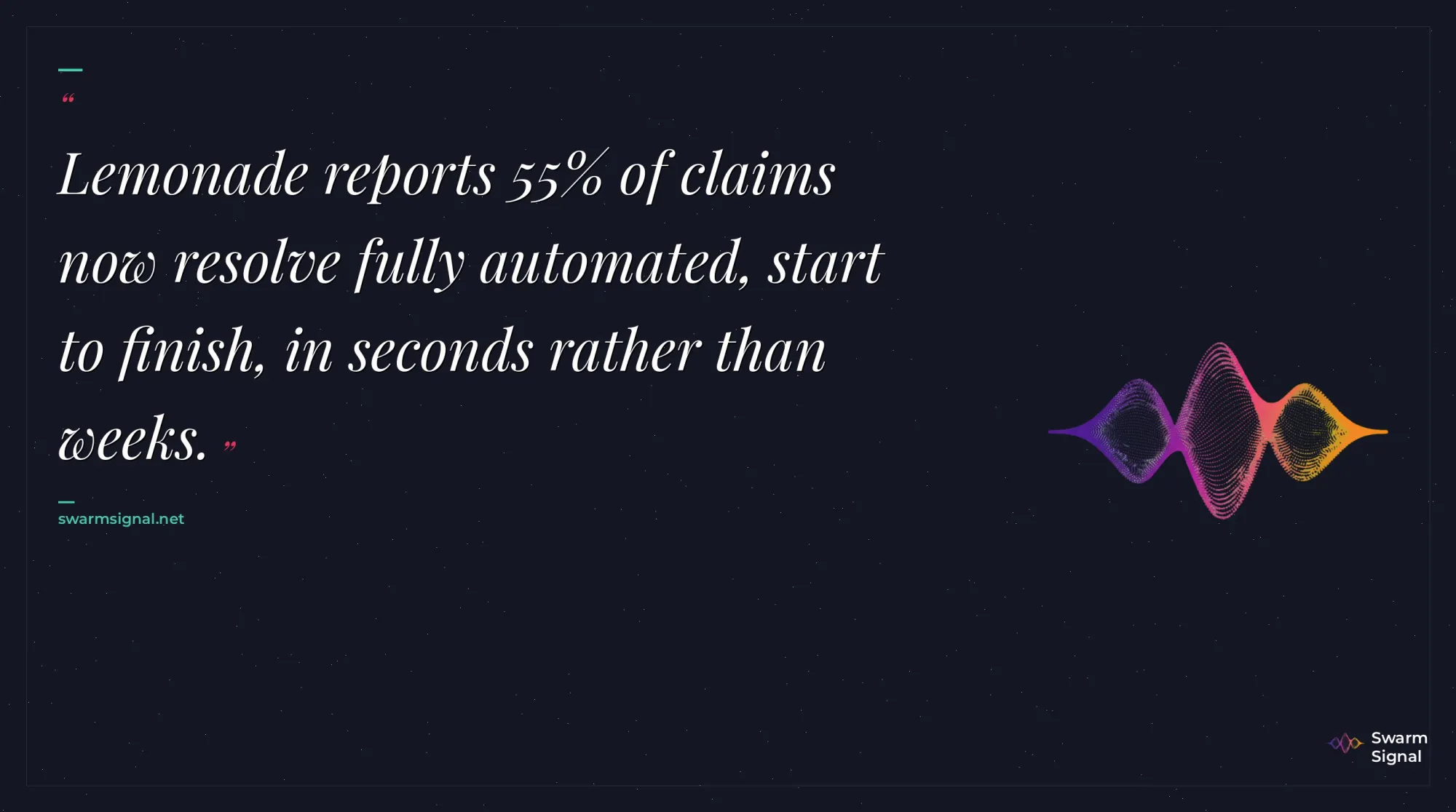
In July 2025, Allianz launched Project Nemo in Australia: seven specialized AI agents processing food spoilage claims end-to-end, from coverage verification to fraud screening to payout recommendation. The system went from concept to production in under 100 days and cut claim processing time by 80%. A few months later, Lemonade reported that 55% of all its claims now resolve fully automated, start to finish, in seconds rather than weeks. Meanwhile, 23 states and Washington, D.C. had adopted the NAIC's Model Bulletin on AI use by insurers, and Colorado's new algorithmic fairness law required quantitative testing for disparate impact in every predictive model touching policyholder decisions.
These three developments tell the whole story of AI agents in insurance right now: carriers are deploying real systems with real results, regulators are building frameworks to constrain them, and the gap between leaders and laggards is widening fast. This guide covers where AI agents are actually working in insurance, what the regulatory constraints look like, and what's producing measurable returns heading into the second half of 2026.
Why Insurance Is a Different Problem
Insurance shares DNA with financial services but operates under a distinct set of constraints that shape how agent systems get built and deployed.
Every state is its own regulator. Unlike banking, where federal regulators set baseline rules, insurance in the US is regulated primarily at the state level. Each of the 50 states has its own insurance commissioner, its own rate approval process, and increasingly its own rules about AI. A model that's compliant in Texas might violate Colorado's algorithmic fairness requirements. A claims automation workflow approved in Florida might need different disclosure language in California. For carriers operating nationally, this patchwork means every AI deployment needs to account for 50+ regulatory environments simultaneously. That's a compliance burden that doesn't exist in most other industries.
The data is messy, multimodal, and adversarial. Insurance claims involve PDFs, photos of damaged property, handwritten medical records, police reports, recorded phone calls, and free-text adjuster notes. Structuring this information for AI processing is harder than parsing financial transactions or electronic health records. And unlike most enterprise AI use cases, a meaningful percentage of the input data is deliberately deceptive. The Coalition Against Insurance Fraud estimates that fraud costs US insurers more than $308 billion annually. Any claims processing agent has to operate in an environment where some percentage of inputs are designed to fool it.
Decisions carry long tails. A denied claim can lead to a lawsuit five years later. An underwriting model that subtly discriminates based on zip code can trigger regulatory action across multiple states. Insurance AI systems need to maintain audit trails and decision logs that remain interpretable years after deployment, not just at the point of decision. This long-tail accountability requirement shapes architecture decisions. You can't use a model version that's been deprecated. You can't lose the reasoning chain. Every agent action needs to be reconstructable, which rules out some of the more freewheeling agent architectures that work fine in lower-stakes domains.
Claims Automation: The Clearest Wins
Claims processing is where insurance AI agents have produced the most documented results. The workflow is a natural fit: high volume, repetitive steps, clear rules, and significant cost pressure.
Lemonade set the benchmark early and keeps extending it. Their claims bot, Jim, processes 27% of claims fully autonomously using natural language processing and behavioral analytics, resolving them in seconds. For pet insurance specifically, over 50% of claims resolve instantly with a 75+ Net Promoter Score. As of late 2025, 96% of first notices of loss are taken by AI chatbots without human intervention. That's not just cost savings. It's a fundamentally different customer experience. Lemonade's pet insurance in-force premium grew 55% year-over-year to $439 million, and total customers hit 2.69 million, suggesting that speed of claims resolution is a genuine competitive advantage, not just an operational efficiency.
Allianz's Project Nemo demonstrates how traditional carriers can deploy agent architectures. The system uses seven task-specific agents: one verifies coverage, another checks for duplicate claims, another screens for fraud indicators, and so on. The complete workflow executes in under five minutes from claim submission to human review readiness. But the design is deliberately conservative. A human makes every final payout decision. Allianz is explicit that "experienced professionals always review and confirm outcomes, keeping fairness and empathy central to every decision." The 80% reduction in processing time comes from automating the preparation work, not the judgment call.
Zurich Insurance lowered contents claim processing to 13 minutes using video analysis where policyholders walk through damaged property on a video call, with AI identifying and cataloging items in real time. Their sensor-based system for commercial buildings monitors for water damage indicators and has reduced water damage claims by 45%, saving an estimated $100 million in claim costs. That's a different kind of AI agent deployment: preventive rather than reactive, using IoT data to stop claims from happening rather than processing them faster after the fact.
Ping An's "Smart Quick Claim" service averages 7.4 minutes from submission to resolution. At Ping An's scale of 1.34 billion customer interactions in just three quarters, even small per-claim time savings compound into massive operational improvements. The approach relies on integrating AI across the entire claims journey: document recognition, damage assessment, fraud scoring, and payment processing all run through connected AI systems rather than isolated point solutions.
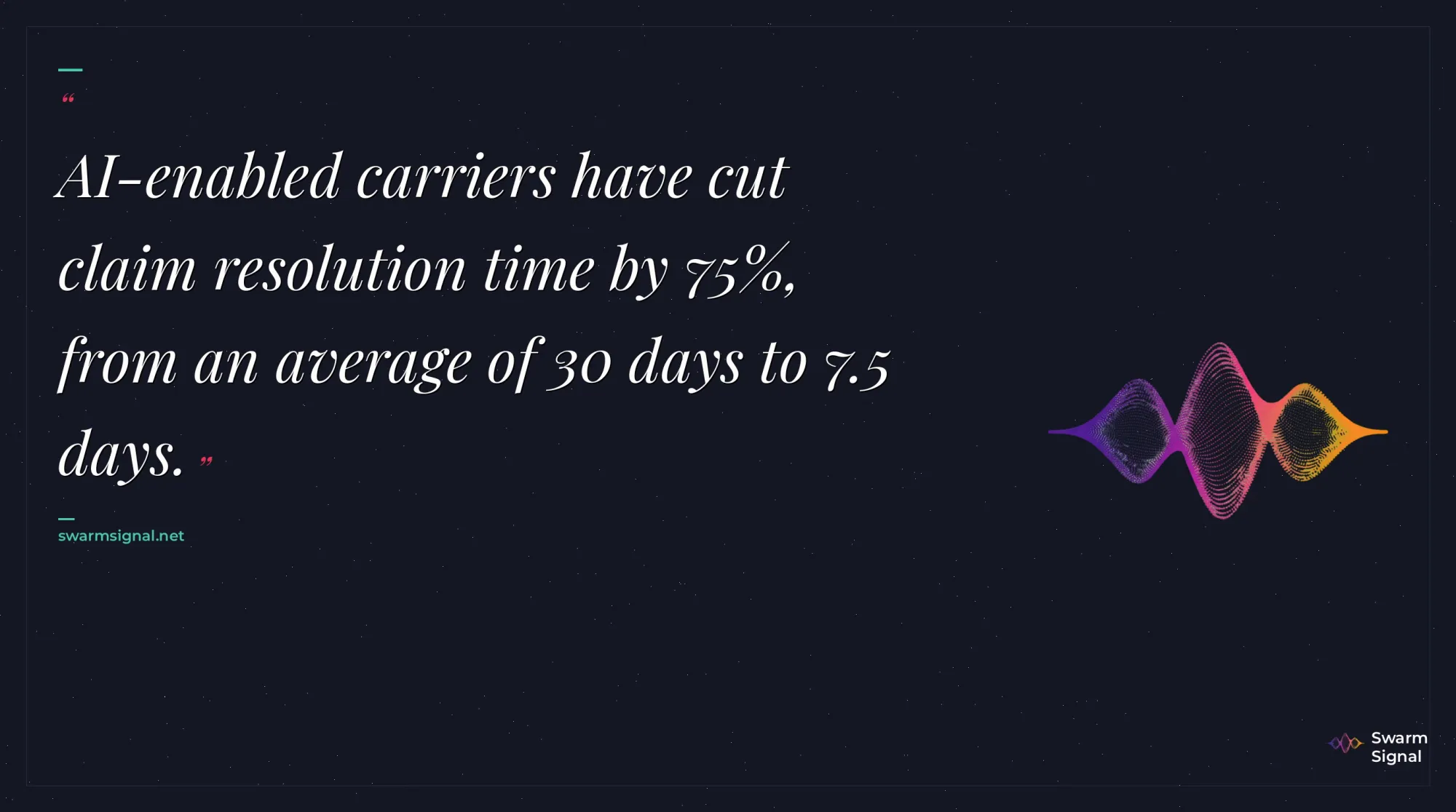
The industry-wide numbers are substantial. AI-enabled carriers have cut claim resolution time by 75%, from an average of 30 days to 7.5 days. Cost per claim has dropped 30-40%, from $40-60 to $25-36. Policy coverage verification, once a 15-20 minute manual process, now completes in seconds with near-99% accuracy. Insurers implementing workflow automation report an average 65% reduction in operational costs across onboarding, policy management, and claims workflows. These aren't projections. They're measured results from carriers already in production.
But the 55% that Lemonade automates are the easy claims. Simple pet insurance claims with clear documentation, straightforward coverage, and small dollar amounts are the ideal use case for full automation. Complex liability claims, disputed coverage, bodily injury cases, and high-value property losses still require human judgment. The pattern across the industry is consistent: AI handles the first 60-80% of the workflow for routine claims and the first 30-40% for complex ones. Deploying agents to production in claims means understanding which claim types are automatable and which aren't.
Underwriting Agents: Speed and Precision
Underwriting is where AI agents are producing some of the most dramatic efficiency gains, and where the regulatory risks are highest.
The speed improvements are striking. AI-assisted underwriting has reduced policy issuance times by up to 80%, according to Deloitte. Standard policies that once took three days to underwrite now average 12.4 minutes. For complex commercial policies, processing times have dropped by 31%. The market reflects this: the underwriting AI segment is projected to grow at a 41.6% CAGR through 2034, the fastest growth rate of any AI application in insurance.
Risk assessment accuracy is improving alongside speed. AI underwriting systems maintain a 99.3% accuracy rate in risk assessment for standard policies, with a 20% improvement in risk assessment accuracy overall. For complex policies, accuracy improvements hit 43%. Early adopters report 30-50% gains in decision accuracy and segmentation precision, meaning they're better at pricing risk correctly, which translates directly to improved loss ratios.
74% of property and casualty carriers have placed AI at the core of their underwriting modernization agendas. That's not experimentation. It's strategic commitment. The driver is competitive pressure: carriers using AI underwriting can quote faster, price more accurately, and process higher volumes without proportional headcount increases. A carrier still doing manual underwriting for standard policies is at a structural disadvantage.
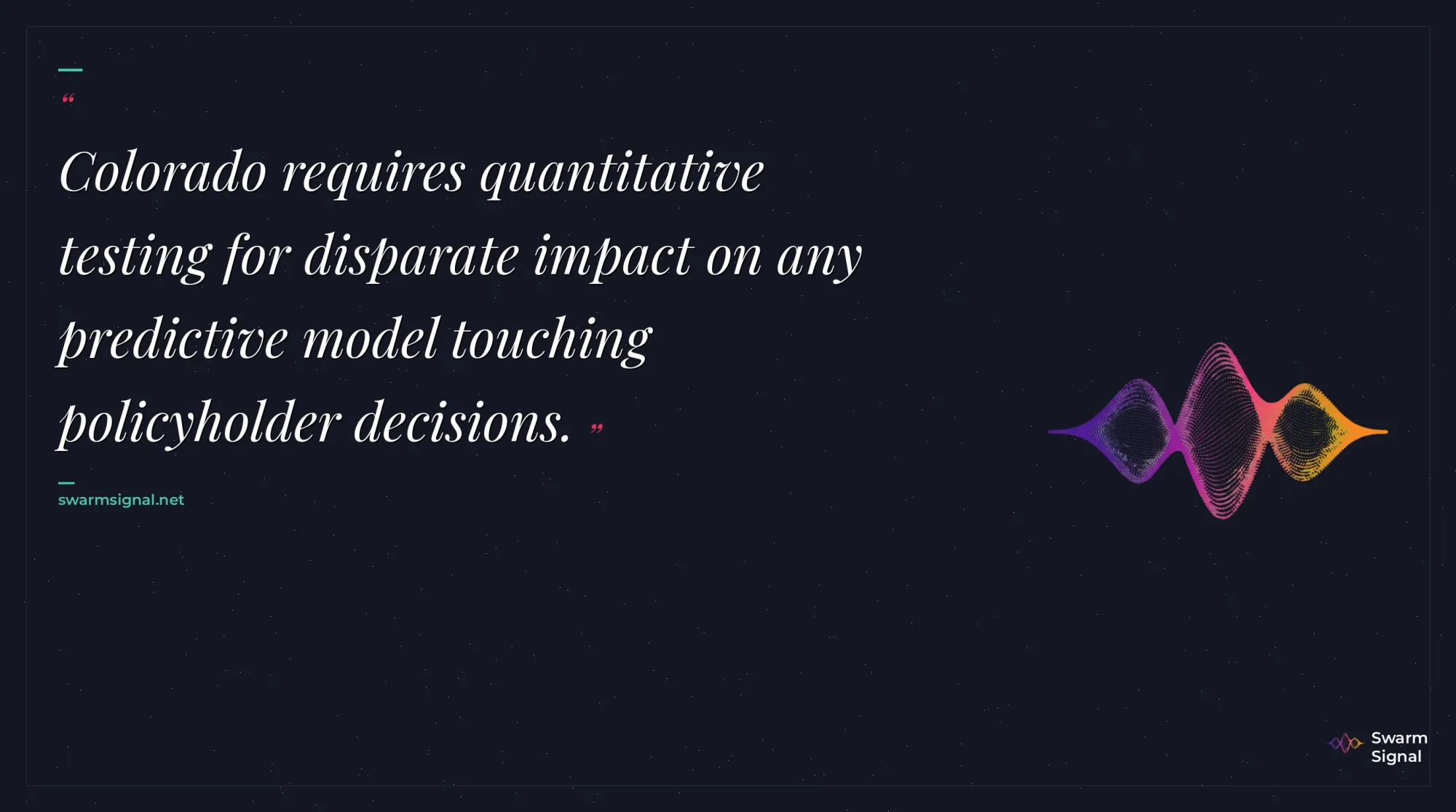
But underwriting is where algorithmic bias risk is highest. Underwriting models that ingest broad data sets, including credit scores, geographic data, social media activity, and consumer behavior patterns, can create proxy discrimination even when they don't explicitly use protected characteristics. A zip-code-based risk factor might correlate tightly with race. A credit-based insurance score might disadvantage demographics that have historically had less access to credit. Colorado's C.R.S. Section 10-3-1104.9 now explicitly prohibits use of external consumer data sources and predictive models that result in unfair discrimination, and requires quantitative testing to detect disparate impact even if the model is facially neutral.
The explainability problem is acute in underwriting. When an insurer denies coverage or charges a higher premium, the policyholder has a right to understand why. State regulators increasingly demand that underwriting decisions be explainable, not just accurate. This creates tension with the most powerful AI models, which tend to be the least interpretable. Carriers are navigating this by building hybrid systems: complex models for risk scoring, with interpretable decision trees that translate the model's output into explanation-ready factors. It's an engineering compromise, but regulators are making it non-negotiable.
Human oversight isn't going away. While AI agents handle the data ingestion, risk scoring, and preliminary decision for standard policies, complex cases and edge cases still route to human underwriters. The industry consensus is moving toward a tiered model: fully automated for simple, low-risk policies; AI-assisted with human review for moderate complexity; and human-led with AI support for large commercial and specialty lines. By late 2026, more than 35% of insurers will deploy AI agents across at least three core functions, but the human underwriter role is evolving, not disappearing.
Fraud Detection: The Adversarial Frontier
Insurance fraud is a $308 billion annual problem in the US alone, and it's the area where AI agents face their most sophisticated opponents.
AI fraud detection is producing measurable results. A global insurer using real-time AI scoring reported 35% fewer false positives and prevented over $30 million in fraudulent payouts annually. UnitedHealth Group achieved a 35% reduction in false positives by using natural language processing to analyze unstructured claims data. False positive reduction matters as much as fraud detection improvement because every false positive means a legitimate claim delayed, a customer frustrated, and an adjuster's time wasted investigating nothing.
Multi-agent fraud detection architectures are emerging. Rather than a single model scoring claims, leading carriers are deploying agent systems where specialized models handle different aspects of fraud detection: one analyzes claim text for inconsistencies, another examines photos for manipulation, another maps claimant networks for coordinated fraud rings, and another cross-references claims history. Allianz's Project Nemo includes fraud screening as one of its seven agent roles. This distributed approach catches patterns that single-model systems miss, particularly organized fraud involving multiple parties and staged claims.
AI-generated fraud is the emerging threat. Guidewire has published research on combating AI-generated media fraud in insurance claims, highlighting how generative AI can produce convincing fake photos of property damage, fabricated medical records, and synthetic identity documents. The same technology that powers claims automation also powers claims fraud. Carriers are now deploying AI systems specifically designed to detect AI-generated content, creating an adversarial dynamic where detection models and generation models continuously evolve against each other.
Data quality determines everything. The research consistently shows that AI fraud models are only as strong as their training data. Incomplete or poor-quality inputs increase both false positives and missed fraud. Clean, well-governed data reduces false positives, lowers model drift, and improves detection consistency. Carriers investing in data infrastructure alongside AI models see materially better results than those bolting AI onto messy legacy data. The safety implications in regulated industries extend directly here: a fraud detection model trained on biased historical data will perpetuate those biases.
The privacy tension is real. Effective fraud detection benefits from more data: cross-carrier databases, public records, social media analysis, location data. But privacy regulations and consumer expectations limit what carriers can collect and use. The European GDPR, state-level privacy laws in California and elsewhere, and the NAIC's own guidance on data use create boundaries that fraud detection systems must operate within. Carriers that push too aggressively on data collection for fraud detection risk regulatory backlash and consumer trust erosion.
The Regulatory Landscape: 50 States, One Industry
Insurance AI regulation is evolving faster than most carriers' compliance teams can track. Here's the current state:
The NAIC Model Bulletin is the baseline. Adopted in December 2023 and now implemented in 23 states plus D.C., the bulletin requires insurers to maintain a documented AI program, implement governance frameworks for AI use, ensure consumers are notified when AI affects decisions, and test for discriminatory outcomes. The bulletin isn't law; it's guidance that state regulators use to set expectations. But as Quarles Law Firm has noted, nearly half of states have now adopted it in some form, making it the de facto national standard.
Colorado is the strictest jurisdiction. Its algorithmic fairness law requires insurers to perform quantitative testing for disparate impact on any external consumer data source or predictive model used in underwriting, rating, or claims. This includes testing for proxy discrimination, where facially neutral variables produce discriminatory outcomes. Colorado also requires carriers to provide specific adverse action notices that explain the role of AI or algorithmic tools in decisions. Other states are watching Colorado's approach closely, and several are expected to introduce similar legislation in 2026.
New York's DFS Circular Letter 2024-7 requires insurers to demonstrate that AI and external data systems do not proxy for protected classes or generate disproportionate adverse effects. New York's approach focuses on outcomes rather than methods: regulators don't prescribe how to test for bias, but they require evidence that the results aren't discriminatory. For carriers operating in New York, this means maintaining bias testing documentation for every model in production.
A model law on third-party oversight is anticipated in 2026. The NAIC is developing guidance that could include licensing requirements for AI vendors serving the insurance industry. This would extend regulatory oversight beyond carriers to the technology companies that build and maintain AI models, a significant expansion of the regulatory perimeter. Carriers relying on third-party AI models would need to ensure their vendors can satisfy regulatory examination requirements.
The EU AI Act creates additional obligations for carriers operating internationally. Insurance underwriting AI systems will likely be classified as "high-risk" under the Act, requiring conformity assessments, transparency documentation, and human oversight mechanisms starting in August 2026. For US carriers with European operations, this adds a compliance layer that intersects with state-level requirements at home.
State-level initiatives are accelerating. Beyond Colorado and New York, states including Connecticut, Illinois, and Virginia have adopted AI-specific insurance requirements. The regulatory trend is clearly toward more oversight, not less. Carriers that build governance infrastructure now will have a significant advantage over those that wait for enforcement actions to force the issue.
What's Actually Working
Honest assessment of where AI agents in insurance stand in early 2026:
Working and deployed:
- Claims triage and automation for simple, well-documented claims (Lemonade, Allianz, Ping An, Zurich)
- First notice of loss intake via conversational AI (96% of Lemonade's FNOL is bot-handled)
- Standard policy underwriting with AI risk scoring (12.4-minute average decision time)
- Fraud detection scoring that reduces false positives by 30-35%
- Document processing and data extraction from claims submissions
- Preventive analytics using IoT and sensor data (Zurich's water damage prevention)
Showing promise but not proven at scale:
- Multi-agent workflows for complex commercial claims
- End-to-end underwriting automation for specialty lines
- AI-generated fraud detection (adversarial detection models are early-stage)
- Cross-state regulatory compliance automation
- Personalized pricing models that satisfy fairness testing requirements
Mostly hype in 2026:
- Fully autonomous claims settlement for complex liability cases
- AI agents that replace human adjusters entirely
- Self-improving underwriting models without human revalidation
- General-purpose insurance AI that handles claims, underwriting, and fraud simultaneously
The contrast with healthcare AI is instructive. In healthcare, regulatory approval can take years and clinical validation is the bottleneck. In insurance, deployment speed is faster but the regulatory patchwork across states creates unique compliance complexity. Both domains require human-in-the-loop, but insurance faces the additional challenge that its AI systems must satisfy dozens of different regulators simultaneously rather than a single federal authority.
Adoption is accelerating regardless. Full AI adoption among insurers jumped from 8% to 34% year-over-year between 2024 and 2025. By the end of 2026, 80% of insurers are expected to have agentic AI solutions in production. The AI in insurance market is projected to grow from $13.45 billion in 2026 to $154.39 billion by 2034, a 35.7% CAGR. The question isn't whether insurance will be transformed by AI agents. It's whether individual carriers will be leading or catching up.
FAQ
How fast can AI agents actually process an insurance claim?
It depends entirely on the claim type. For simple, well-documented claims like Lemonade's pet insurance, resolution can happen in seconds. Lemonade famously paid a claim in three seconds, with its bot reviewing the claim, checking the policy, and issuing payment instructions almost instantly. For low-complexity property claims, Allianz's seven-agent system completes the full workflow in under five minutes. For standard auto and home claims, AI-enabled carriers average 7.5 days versus the traditional 30-day timeline. Complex liability and bodily injury claims still take weeks or months, with AI handling preparation and documentation while human adjusters manage the judgment-intensive portions.
Will AI underwriting models create discriminatory pricing?
They can, and regulators are building frameworks specifically to prevent it. The core risk is proxy discrimination: models that don't use protected characteristics directly but rely on variables that correlate with them, like zip code correlating with race or credit score correlating with income. Colorado requires quantitative disparate impact testing. New York requires proof that models don't proxy for protected classes. The NAIC's Model Bulletin mandates governance programs that address discriminatory outcomes. Carriers using AI underwriting need ongoing bias monitoring, not just pre-deployment testing, because model behavior can drift over time as data distributions shift.
What happens when an AI claims agent makes the wrong decision?
The carrier is liable. AI doesn't transfer accountability. If an AI agent wrongly denies a claim, the policyholder has the same legal recourse as with a human denial: internal appeal, state insurance commissioner complaint, or litigation. This is precisely why carriers maintain human review on final decisions. The regulatory expectation, codified in the NAIC bulletin and state-level rules, is that insurers remain responsible for outcomes regardless of whether a human or AI system produced them. Carriers deploying claims agents need clear escalation paths, override capabilities, and audit trails that can reconstruct the AI's reasoning for any disputed decision.
How should carriers approach AI vendor selection for insurance?
Treat vendor governance as a regulatory requirement, not a procurement preference. The NAIC is developing third-party oversight guidance expected in 2026 that may include vendor licensing requirements. In the meantime, carriers should require vendors to demonstrate bias testing methodologies, provide model documentation sufficient for regulatory examination, maintain audit trails compatible with state requirements, and contractually commit to ongoing model monitoring. Ask whether the vendor's models have been validated against your specific state regulatory requirements, not just general fairness benchmarks. A model validated for Texas may not satisfy Colorado's quantitative testing requirements.
Sources:
- Allianz: Project Nemo Agentic AI Claims Automation
- Lemonade: Claims Automation
- Lemonade Q2 2025: AI-Driven Insurance Results
- Deloitte: Using AI to Fight Insurance Fraud
- NAIC: Model Bulletin on Use of AI by Insurers
- Quarles: Nearly Half of States Have Adopted NAIC AI Model Bulletin
- Holland & Knight: Implications of the NAIC Model AI Bulletin
- Colorado C.R.S. §10-3-1104.9 Algorithmic Fairness
- Guidewire: Combating AI-Generated Media Fraud
- Zurich AI Lab and Insurance AI Initiatives
- Roots Automation: 10 Insurance AI Predictions for 2026
- Fortune Business Insights: AI in Insurance Market Size
- Datagrid: 42 Insurance AI Agent Statistics
- PwC: Risk Detect Insurance Fraud
- Buchanan Ingersoll: Insurance Regulators Demanding Explainable AI
- Kennedys: Understanding the NAIC Model AI Bulletin