

▶️ LISTEN TO THIS ARTICLE
On January 27, 2025, Nvidia lost $589 billion in market capitalization in a single day. The cause wasn't an earnings miss or a product failure. It was a Chinese AI lab called DeepSeek, which had just demonstrated that you could train a GPT-4-class model for $5.6 million instead of the $100 million-plus that American labs typically spend. The model, trained on 2,048 Nvidia H800 GPUs over 55 days, matched or beat GPT-4 on multiple benchmarks while costing a fraction of the price.
DeepSeek's achievement exposed a paradox at the center of China's AI strategy. The country invested 890 billion yuan ($125 billion) in AI in 2025, representing 38% of global AI investment. Yet Stanford's 2025 AI Index Report found that U.S. private AI investment hit $109.1 billion in 2024 alone, nearly 12 times China's $9.3 billion in private capital. China spends massively on AI. Most of that money comes from the state, not the market.
Where the Money Goes
In January 2025, Beijing launched the National AI Industry Investment Fund with 60 billion yuan ($8.2 billion) in initial capital, structured as a joint venture between state-backed Guozhi Investment and the China Integrated Circuit Industry Investment Fund. This sits within a broader $138 billion National Venture Capital plan designed to funnel state resources across the full AI supply chain, from chips to applications.
The scale of China's AI industry reflects that spending. According to a World Economic Forum whitepaper, China has cultivated over 4,300 AI companies and an industry valued above $70 billion annually. By the end of 2025, China's official statistics put the core AI industry at over 1 trillion yuan, with a Caixin estimate of $172 billion including manufacturing integration.
But the composition is telling. Chinese AI investment runs heavily toward applications: computer vision (18% of total investment), autonomous vehicles (22%), fintech (12%), and NLP (11%), according to Second Talent's analysis. That application focus is deliberate. Beijing's 14th Five-Year Plan calls for "comprehensive intelligent transformation" of industrial production, with AI embedded across 70% of key sectors by 2027 and 90% by 2030. Chinese President Xi Jinping frames AI as "application-oriented," favoring city-brain pilots and IoT integration over frontier model research.
The contrast with the U.S. is stark. American AI spending concentrates on frontier foundation models and the infrastructure to train them. China is wiring intelligence into the physical economy at scale, a deployment-first philosophy that Japan's Physical AI strategy mirrors from a very different starting position.
What DeepSeek Actually Proved
DeepSeek's founder, Liang Wenfeng, said it plainly: "Money has never been the problem for us; bans on shipments of advanced chips are the problem." Before the U.S. tightened export controls, Liang stockpiled an estimated 10,000 to 50,000 Nvidia A100 chips. The company then trained competitive models on H800 GPUs, chips Nvidia had designed specifically for the Chinese market with reduced NVLink bandwidth to comply with October 2022 export rules.
The R1 reasoning model cost just $294,000 to train using 512 H800 chips, and it outperformed GPT-4 on several benchmarks: 90.8% on MMLU (vs. GPT-4's 87.2%), 79.8% on AIME 2024 mathematics (vs. 9.3%), and a Codeforces score of 2,029 (vs. 759). Those headline numbers are impressive, though benchmark scores alone can be misleading when comparing fundamentally different training approaches. The results suggested that software innovation and efficient training techniques could partially compensate for hardware constraints.
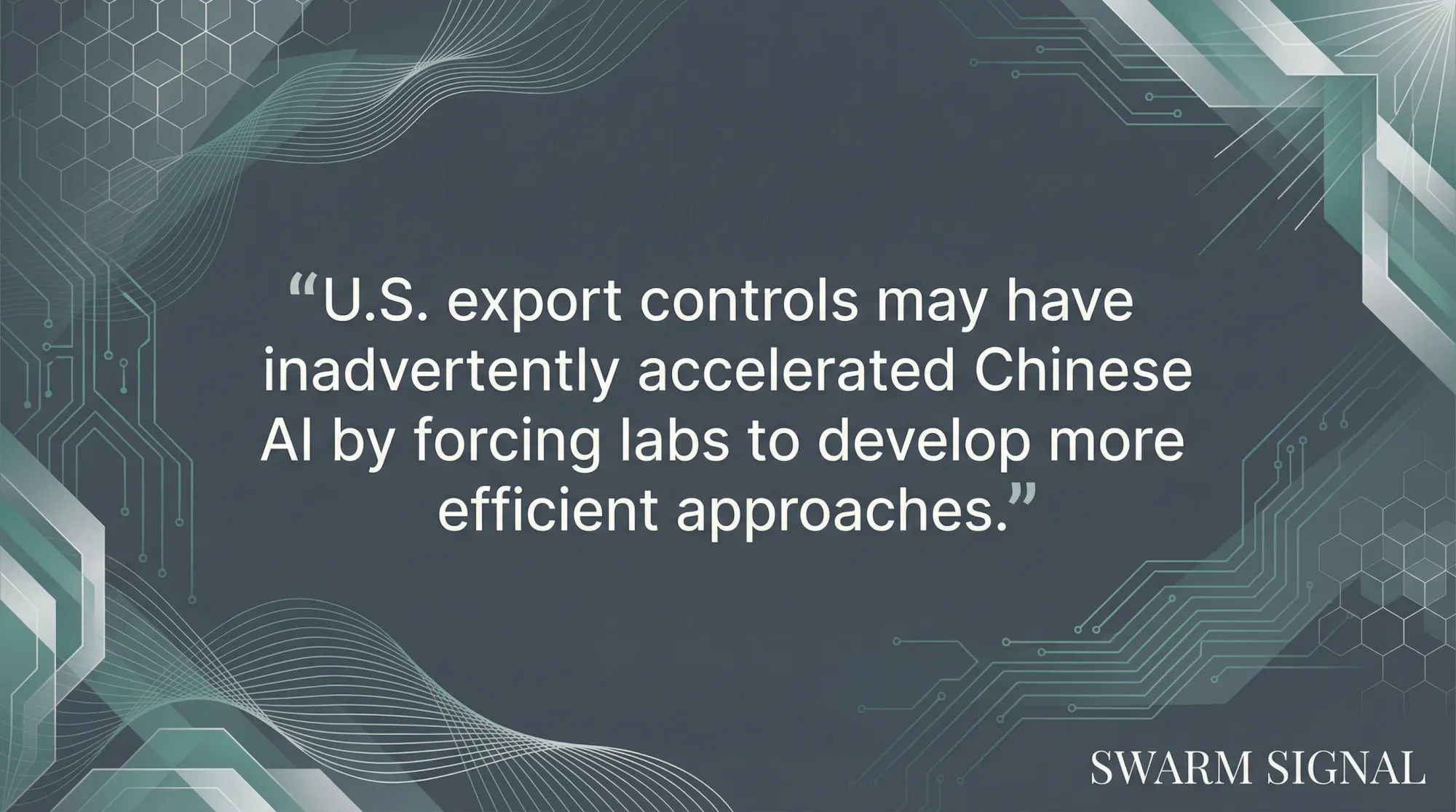
Brookings assessed that U.S. export controls, rather than blocking Chinese AI progress, may have inadvertently accelerated it by forcing Chinese labs to develop more efficient approaches. RAND's analysis concluded the lesson wasn't that controls don't work, but that they need to be smarter.
Still, one efficient model doesn't resolve the structural constraint. DeepSeek succeeded in part because it had legacy chips stockpiled before the bans took full effect. Sustaining frontier-level research requires ongoing access to cutting-edge hardware, and that's exactly what China can't reliably get.
The Chip Problem Hasn't Gone Away
The U.S. first banned exports of Nvidia's A100 and H100 chips to China in October 2022. Nvidia responded by designing the A800 and H800 as compliant alternatives. In October 2023, the Commerce Department closed that loophole, banning the A800, H800, L40, L40S, and RTX 4090 as well.
China's domestic response centers on Huawei's Ascend chips. The Ascend 910B reportedly matches or slightly exceeds Nvidia's A100 in training performance, and Ascend solutions were used to train roughly half of China's top 70 large language models as of late 2024. SMIC, China's leading foundry, successfully ramped up 7nm chip production for AI accelerators in 2025 and produced the Kirin 9030 processor for Huawei's latest smartphones.
But the gap remains substantial. China's domestic chips are competitive with Nvidia's A100 generation, not the current Blackwell architecture. South Korea's Samsung and SK Hynix control the HBM memory those chips depend on, adding another layer of supply chain vulnerability. EUV lithography equipment, critical for next-generation chips, won't be ready for Chinese mass production until around 2030. Domestic semiconductor equipment market share is expected to rise to 25% in 2025, up from 20%, but that still means 75% comes from foreign suppliers.
The policy picture has gotten messier. The Trump administration reversed some Biden-era restrictions, approving exports of Nvidia's H20 inference chip and later the H200 to China, while claiming a 25% revenue share for the U.S. The Council on Foreign Relations called the new policy "strategically incoherent and unenforceable." The result is that China's hardware access is neither fully blocked nor fully open, creating an unstable middle ground.
The 2030 Deadline
China's stated goal is AI parity with the United States by the end of the decade. RAND's full-stack analysis of China's AI industrial policy shows Beijing deploying tools across the entire technology stack, from chip design to end-user applications. Morgan Stanley's assessment is that China is "quickly becoming an AI global leader," with particular strength in industrial applications where integration with manufacturing and infrastructure matters more than raw model capability.
The state-led model has real advantages for deployment at scale. When the Chinese government decides that autonomous vehicles or smart city infrastructure should use AI, it can direct procurement across thousands of cities simultaneously. That kind of coordinated rollout simply doesn't happen in market-driven economies.
But the model has blind spots. Private venture capital signals market confidence and directs resources toward commercially viable ideas through thousands of independent bets. China's $9.3 billion in private AI investment, compared to America's $109.1 billion, suggests the market hasn't matched the state's enthusiasm. Carnegie's assessment that China's plan to integrate AI into 90% of its economy by 2030 "won't work" reflects skepticism about top-down mandates in a technology that evolves faster than five-year plans.
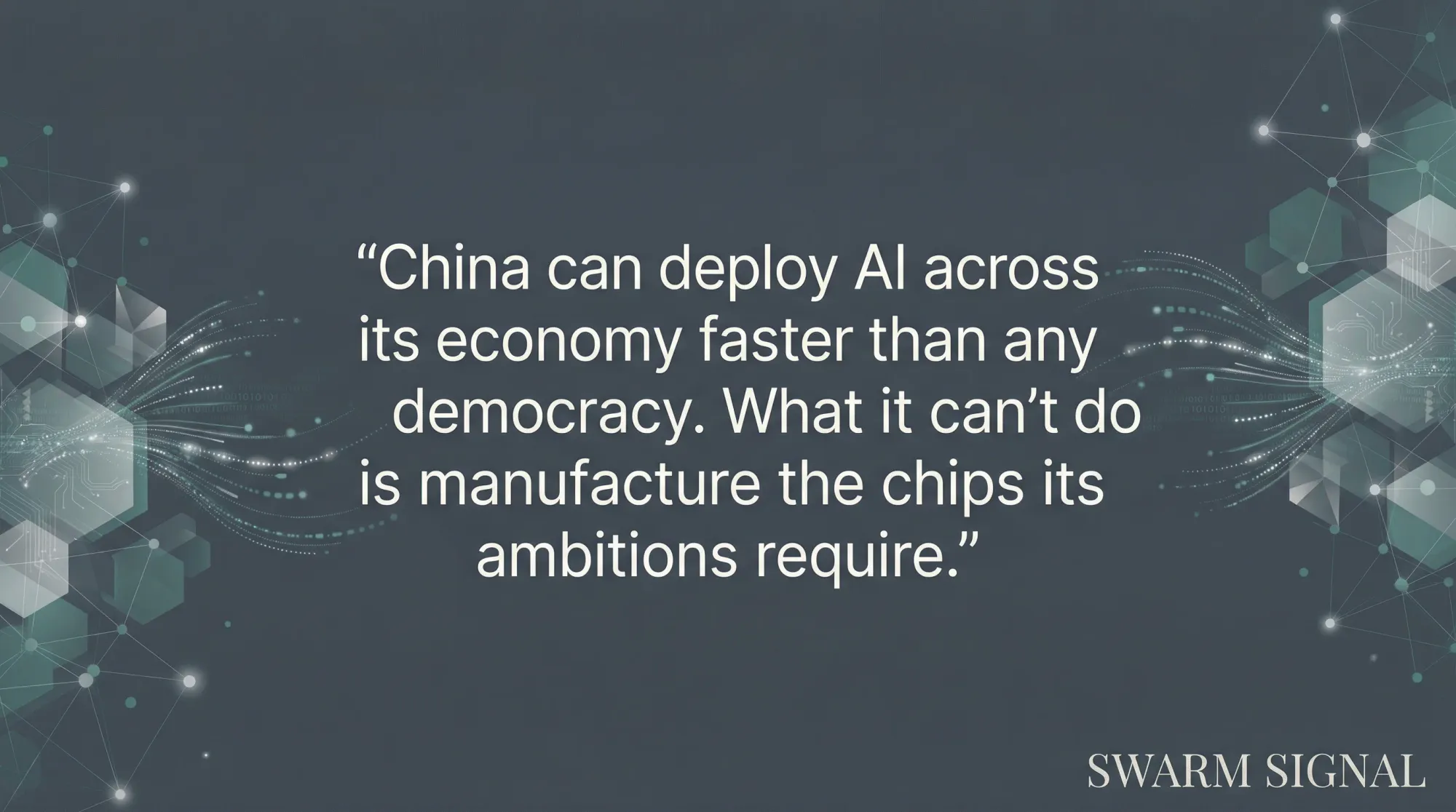
China can direct capital at unprecedented scale, deploy AI applications across its economy faster than any democracy, and produce research talent in staggering quantities. What it can't yet do is manufacture the chips its ambitions require or replicate the private investment culture that drives the frontier model competition. The $125 billion annual spend is real. Whether it's enough depends on problems that money alone can't solve.
Sources
Research Papers:
- Stanford's 2025 AI Index Report — Stanford HAI (2025)
- $138 billion National Venture Capital plan — RAND Corporation (2025)
- World Economic Forum whitepaper — World Economic Forum (2025)
- China's official statistics — State Council of China (2025)
- Banned exports of Nvidia's A100 and H100 chips to China in October 2022 — Congressional Research Service
Industry / Case Studies:
- $589 billion in market capitalization — CNN
- $5.6 million — MIT Technology Review
- 890 billion yuan ($125 billion) in AI in 2025 — Second Talent
- National AI Industry Investment Fund — South China Morning Post
- Caixin estimate — Caixin Global
- Comply with October 2022 export rules — CNBC
- Ascend 910B — WCCFTech
- Train roughly half of China's top 70 large language models — South China Morning Post
- 7nm chip production for AI accelerators in 2025 — China Crunch
- Kirin 9030 processor — Bloomberg
- Reversed some Biden-era restrictions — Built In
- H200 to China — CNN
Commentary:
- "Comprehensive intelligent transformation" of industrial production — Carnegie Endowment
- Frames AI as "application-oriented" — Foreign Policy Research Institute
- "Money has never been the problem for us" — Brookings Institution
- RAND's analysis — RAND Corporation
- Won't be ready for Chinese mass production until around 2030 — Georgetown CSET
- Council on Foreign Relations called the new policy — Council on Foreign Relations
- Morgan Stanley's assessment — Morgan Stanley
Related Swarm Signal Coverage: