

🎧 LISTEN TO THIS ARTICLE
By Tyler Casey · AI-assisted research & drafting · Human editorial oversight
@getboski
There are now over 20 agent frameworks competing for your stack. Most of them won't survive the year. Some are research projects wearing production clothing. Others are marketing wrappers around a single API call. And a few are genuinely solving the hardest problem in AI engineering: making agents that don't fall apart when real users hit them.
We ranked eight frameworks that actually matter in 2026, using one filter above all others: can you ship this to production and sleep at night? Not playground demos. Not "works in a notebook." Production. With users. And logs. And the 3 AM pages that come with them.
How We Ranked Them
Five criteria, weighted by what actually kills projects in production:
- Production deployments. Who's running this at scale? Named customers matter more than star counts.
- Documentation quality. Can a mid-level engineer onboard in a week without reading source code?
- Community and ecosystem. Active maintainers, third-party integrations, Stack Overflow answers that aren't six months stale.
- Architectural flexibility. Can you escape the framework's opinions when your use case demands it?
- Enterprise support. Paid tiers, SLAs, SOC 2 compliance, the boring stuff that procurement teams care about.
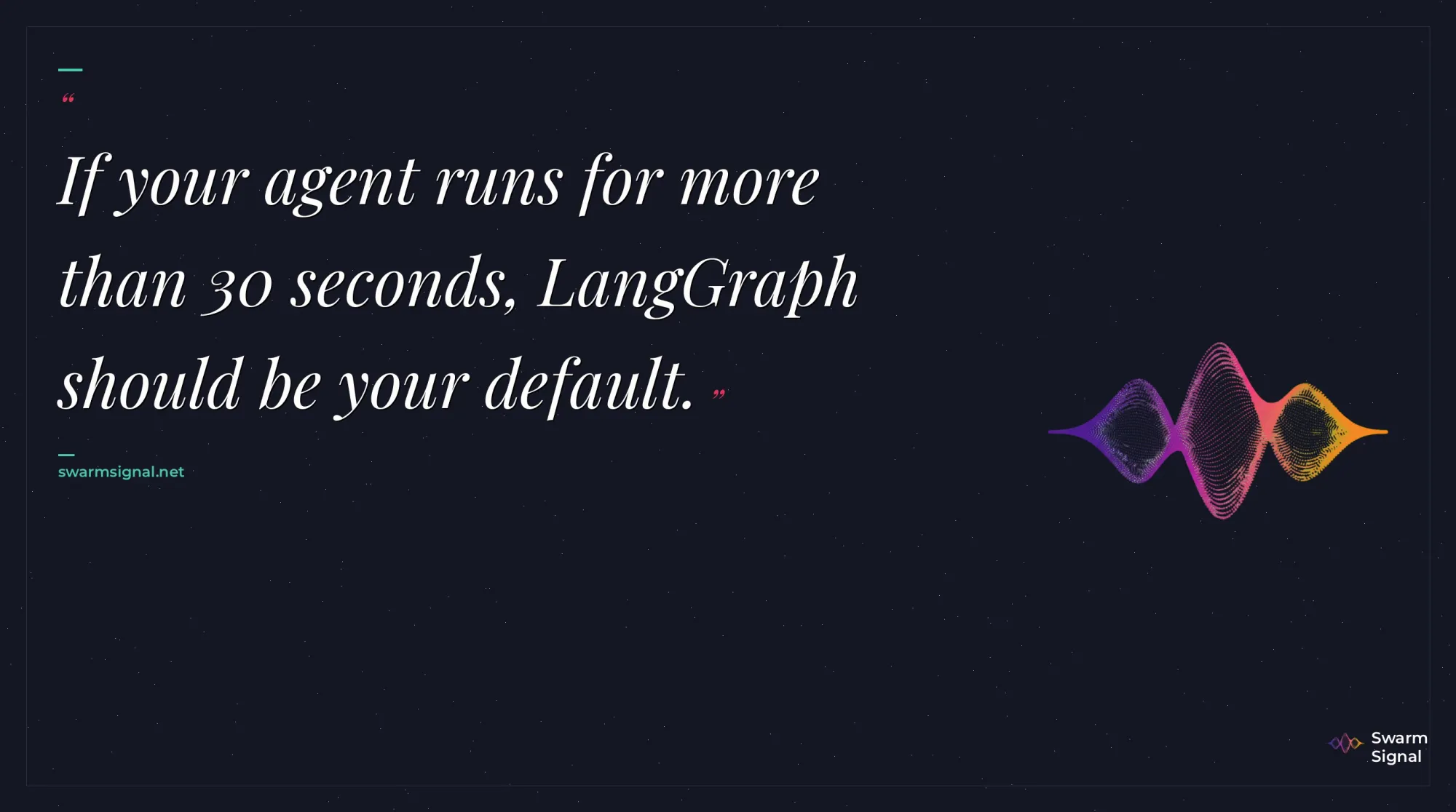
GitHub stars appear in the table below because developers ask about them. But stars measure awareness, not reliability. A framework with 50,000 stars and no production deployment guide is less useful than one with 15,000 stars and a battle-tested deploy playbook.
At a Glance
| Rank | Framework | Best For | GitHub Stars | Pricing | Production Ready? |
|---|---|---|---|---|---|
| 1 | LangGraph | Complex stateful workflows | ~14,000 | Open source + paid platform | Yes (GA since 2025) |
| 2 | CrewAI | Multi-agent teams, fast prototyping | ~45,900 | Open source + Enterprise (AMP) | Yes |
| 3 | OpenAI Agents SDK | Lightweight tool-use agents | ~16,000 | Free (pay for OpenAI API) | Growing (pre-1.0) |
| 4 | Pydantic AI | Type-safe Python pipelines | ~15,500 | Open source | Yes |
| 5 | Semantic Kernel | Enterprise .NET/Python/Java | ~27,400 | Free (Microsoft-backed) | Yes |
| 6 | Google ADK | Gemini-native, multi-language | ~15,600 | Free (pay for Vertex AI) | Early |
| 7 | AutoGen / AG2 | Research, conversational agents | ~50,400 | Open source | Declining |
| 8 | DSPy | Optimized LM pipelines, research | ~23,000 | Open source | Niche |
1. LangGraph: The Control Plane for Serious Agent Work
LangGraph isn't the most popular framework by star count, and that's precisely why it ranks first. While other frameworks optimized for first impressions, LangGraph optimized for the problems you hit on month three of a production deployment.
The architecture is straightforward: agents are directed graphs where nodes are LLM calls, tool executions, or custom functions, and edges define the flow between them. State persists across every step through built-in checkpointing. When your agent crashes mid-workflow (and it will), LangGraph picks up exactly where it left off. That's not a feature you appreciate in a demo. It's the feature that saves a production deployment.
Companies like Replit, Uber, LinkedIn, and Klarna run LangGraph in production. The parent organization, LangChain, has processed over 15 billion traces through LangSmith and serves 300+ enterprise customers. The LangGraph Platform handles deployment and scaling, so you're not stitching together your own orchestration layer.
The tradeoff is ramp-up time. Expect one to two weeks before a team is productive, compared to hours with simpler frameworks. Graph-based thinking isn't intuitive for everyone, and the documentation, while comprehensive, assumes familiarity with state machine concepts.
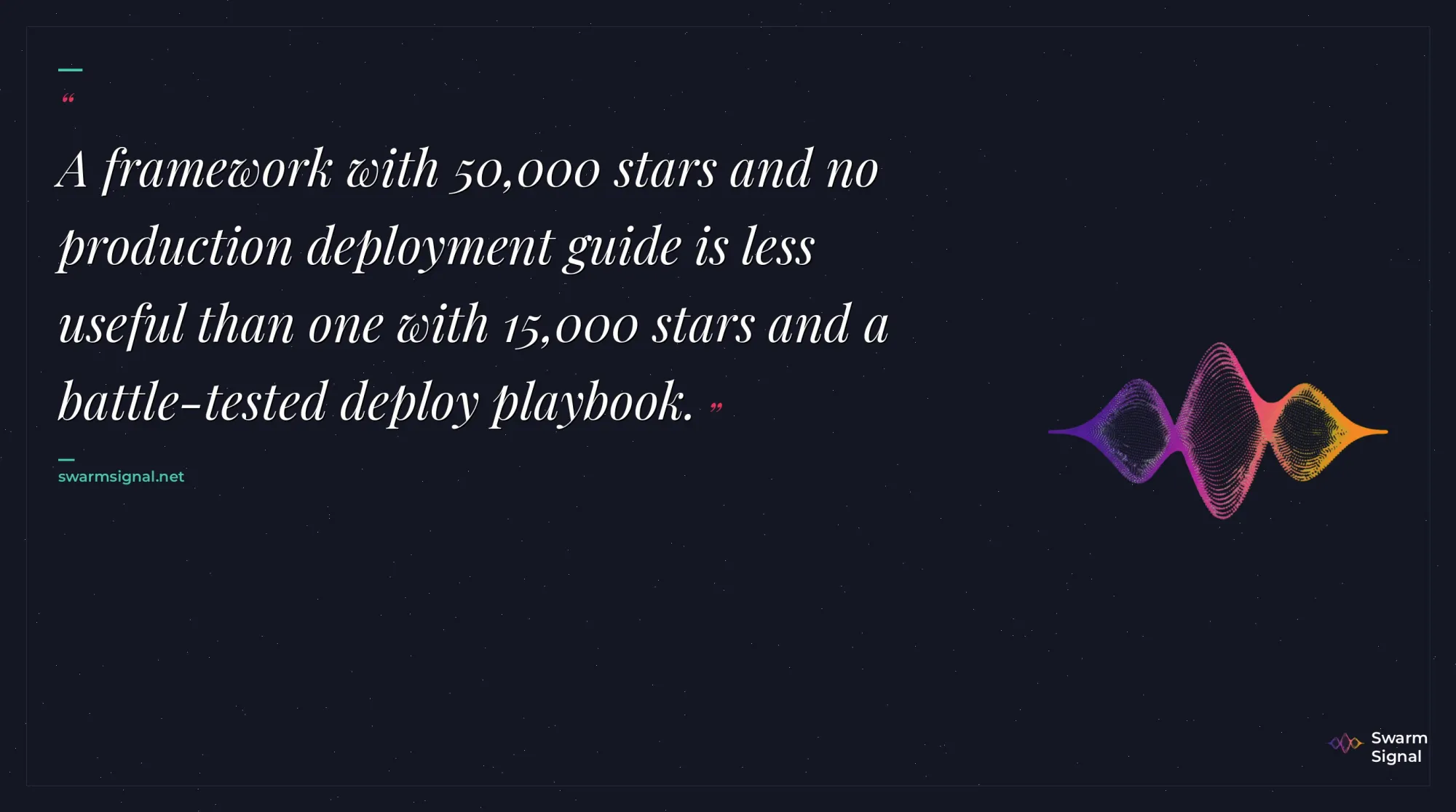
Best for: Teams building agents that need durable execution, human-in-the-loop checkpoints, and long-running multi-step workflows. If your agent runs for more than 30 seconds, LangGraph should be your default.
Watch out for: The learning curve is real. If you just need a chatbot with tool calling, this is overkill. See our full framework comparison for head-to-head benchmarks.
2. CrewAI: The Fastest Path From Idea to Multi-Agent System
CrewAI has the simplest mental model on this list: define roles, assign tasks, let agents collaborate. A researcher agent gathers data. A writer agent drafts content. A reviewer agent checks quality. You describe the crew and CrewAI handles the coordination.
That simplicity has driven explosive growth. With 45,900+ GitHub stars and over 100,000 certified developers, CrewAI is the most popular multi-agent framework by community size. Benchmarks show it executing multi-agent workflows 2-3x faster than comparable frameworks, which matters when latency directly affects user experience.
The framework ships two modes: Crews for autonomous collaboration and Flows for structured enterprise pipelines. Flows is where production teams spend most of their time. It provides the control and observability that Crews alone can't deliver at scale.
CrewAI's enterprise tier, AMP, targets organizations deploying agents across departments. It covers the full lifecycle from development through production scaling. Native support for MCP (Model Context Protocol) and A2A (Agent-to-Agent) protocol means your agents can plug into the broader ecosystem without custom integration work.
The ceiling shows up around month six to twelve on complex systems. When you need fine-grained control over exactly what happens between agent turns, the role-based abstraction can feel limiting. Teams that outgrow CrewAI typically migrate to LangGraph.
Best for: Rapid prototyping, content pipelines, research workflows, and teams that want multi-agent collaboration without building the plumbing themselves.
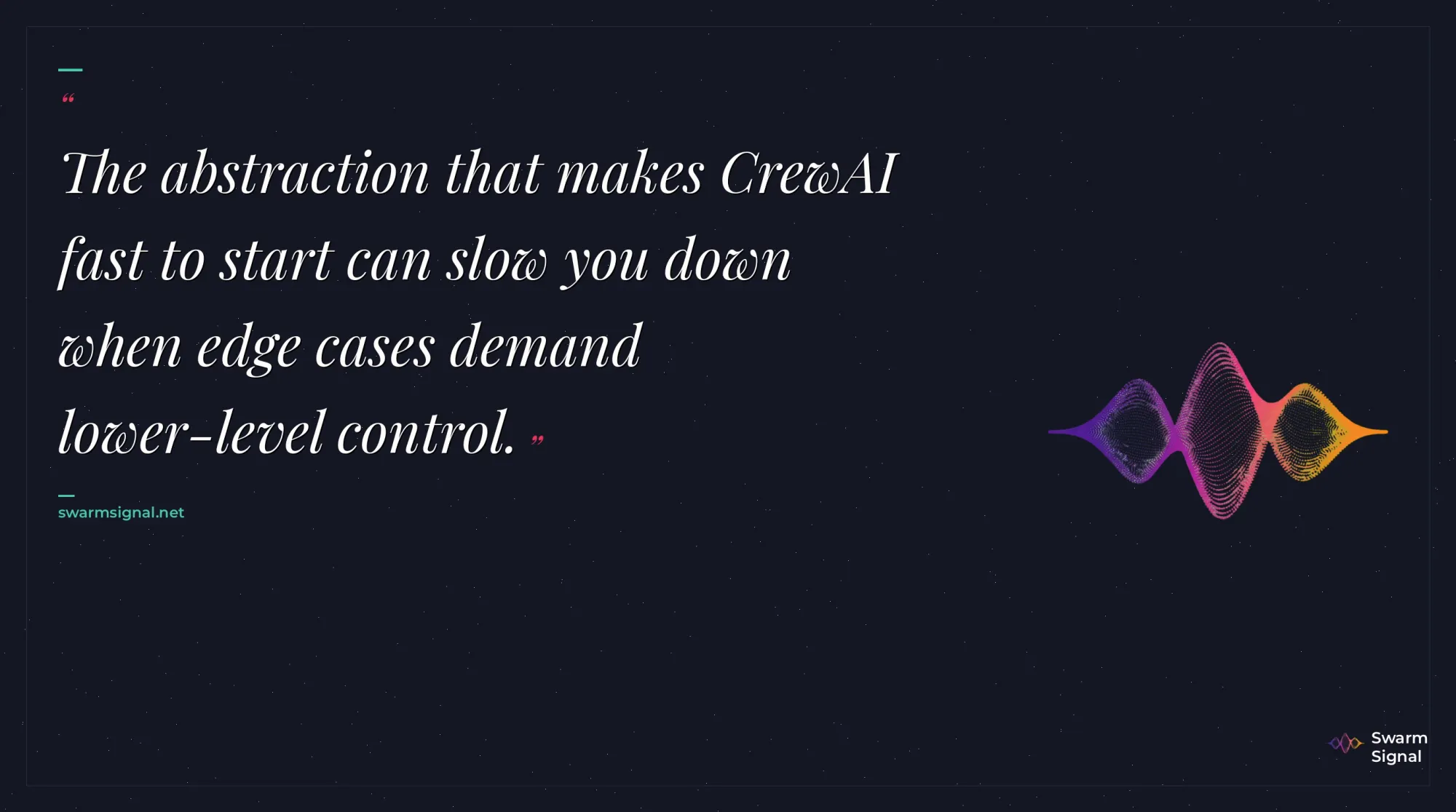
Watch out for: The abstraction that makes CrewAI fast to start can slow you down when edge cases demand lower-level control. Read our guide to types of AI agents to understand which architectures fit which problems.
3. OpenAI Agents SDK: Lightweight, Vendor-Backed, and Evolving Fast
The Agents SDK is OpenAI's production successor to Swarm, their earlier experimental framework. The pitch is minimalism: agents, tools, handoffs, and guardrails. That's the entire API surface. No graphs, no role definitions, no workflow engines. Just the primitives you need to build tool-using agents and let them delegate to each other.
Despite the OpenAI branding, the SDK is provider-agnostic. It supports 100+ LLMs through documented integration paths, so you're not locked into GPT models. Built-in tracing lets you visualize every agent decision, and Sessions handle conversation history management across runs automatically.
The SDK is still pre-1.0, which is both a risk and an opportunity. The API is changing. Breaking changes happen. But OpenAI is iterating faster than any other framework on this list, and the tight integration with their Responses API gives you access to web search, file search, and computer use capabilities that other frameworks require plugins to match.
Voice agents are a differentiator. The Realtime Agents feature supports automatic interruption detection, context management, and guardrails for voice-first applications. No other framework on this list handles voice natively.
Best for: Teams already using OpenAI's API who want to add agent capabilities without adopting a heavyweight framework. Excellent for chatbots, tool-use agents, and voice applications.
Watch out for: The pre-1.0 status means you'll be updating code as the API stabilizes. Long-running workflows lack the checkpointing and durability that LangGraph provides. If you're building your first AI agent, this is a solid starting point.
4. Pydantic AI: Type Safety as a Production Strategy
Pydantic AI takes a contrarian position: the biggest production risk isn't your agent's reasoning. It's the untyped data flowing between your agent and everything else. Bad inputs, malformed tool responses, schema mismatches. These are the bugs that slip past testing and explode in production at 2 AM.
The framework wraps agent development in Python's type system. Your IDE catches errors before they reach production. Structured outputs are validated automatically. If an LLM returns JSON that doesn't match your Pydantic model, you know immediately, not when a downstream service crashes.
With 15,500 GitHub stars and growing, Pydantic AI has emerged as the choice for teams that already use Pydantic (which is most Python teams). Integration with Logfire provides real-time debugging, tracing, and cost tracking. The framework supports MCP, A2A, and virtually every major model provider.
The tradeoff is scope. Pydantic AI doesn't try to be an orchestration framework or a multi-agent coordinator. It's an agent framework that prioritizes correctness over features. Teams building complex multi-agent systems will pair it with an orchestration layer.
Best for: Python teams that value type safety, data validation, and correctness guarantees. Ideal for data pipelines, API-backed agents, and systems where output schema compliance is non-negotiable.
Watch out for: You'll need additional tooling for multi-agent orchestration and complex workflows.
5. Semantic Kernel: The Enterprise Framework Nobody Talks About
Semantic Kernel has 27,400 GitHub stars but generates a fraction of the Twitter discourse that CrewAI or LangGraph attract. That's because its users are building internal enterprise tools, not tweeting about them. This is the framework Microsoft built for Microsoft's own AI products, and it shows.
Multi-language support (C#, Python, Java) sets it apart immediately. If your organization runs .NET, Semantic Kernel is the only first-class option on this list. The framework provides token counting, budget controls, role-based access, secure credential management, and telemetry integration out of the box. These aren't plugins. They're core features.
The agent framework layer enables modular agents with tools, memory, and planning capabilities. Multiple memory backends (in-memory, Redis, Azure Cognitive Search) let you scale from development through production without swapping architectures.
Microsoft is merging AutoGen's best ideas into Semantic Kernel under the new "Microsoft Agent Framework" umbrella. This consolidation signals long-term investment and means Semantic Kernel will inherit AutoGen's conversational agent patterns while maintaining enterprise-grade stability.
Best for: Enterprise teams, especially those in the Microsoft ecosystem. Organizations that need .NET support, SOC 2 readiness, and procurement-friendly licensing.
Watch out for: Community resources skew toward Microsoft's ecosystem. If you're building with Python-only tooling and don't need enterprise governance features, lighter frameworks will move faster.
6. Google ADK: The Gemini-Native Newcomer
Google's Agent Development Kit launched in late 2024 and has accumulated 15,600 GitHub stars with implementations in Python, TypeScript, Go, and Java. That multi-language spread is unusual for an agent framework and reflects Google's strategy: meet developers wherever they already are.
ADK is optimized for Gemini but explicitly model-agnostic. It supports code execution, Google Search grounding, context caching, and computer use natively. The built-in evaluation tools let you test agents systematically, which most frameworks still treat as an afterthought.
The Vertex AI integration provides a clear path from prototype to production on Google Cloud, with managed deployment and scaling. For teams already on GCP, ADK removes the infrastructure gap that plagues other frameworks.
The framework is still young. Documentation has gaps. The community is smaller than established alternatives, and production case studies are limited. Google's track record of abandoning developer products is the elephant in the room, though the deep integration with Vertex AI suggests longer commitment.
Best for: Teams on Google Cloud, Gemini-first shops, and developers who want a single framework across Python, TypeScript, Go, and Java.
Watch out for: Limited production track record. Google's product continuity reputation creates legitimate adoption risk.
7. AutoGen / AG2: The Research Giant Facing an Identity Crisis
AutoGen's 50,400 GitHub stars make it the second most-starred framework on this list. But stars tell the adoption story of 2024, not 2026. The framework is going through a significant transition that prospective adopters need to understand.
Microsoft spun AutoGen out into AG2, an independent organization, in late 2024. The original AutoGen repo remains under Microsoft's GitHub but is entering maintenance mode. Significant new features go to the Microsoft Agent Framework (built on Semantic Kernel) instead. AG2 continues independent development with open governance, but the split has fragmented the community.
The conversational agent pattern that made AutoGen famous remains powerful. Agents chat with each other, negotiate, and reach consensus. For research and experimentation, this flexibility is unmatched. The code execution sandbox and human-in-the-loop patterns are well-tested.
But the fragmentation creates real risk. Which version do you adopt? AG2 for community governance? Semantic Kernel for Microsoft backing? AutoGen's legacy codebase? Each answer leads to a different ecosystem with different maintainers and different roadmaps.
Best for: Research teams, academic projects, and organizations experimenting with conversational multi-agent patterns.
Watch out for: The community split means reduced maintainer focus on any single codebase. Production teams should evaluate Semantic Kernel or LangGraph instead. For a detailed breakdown of how AutoGen compares to its closest rivals, see our AutoGen vs CrewAI vs LangGraph analysis.
8. DSPy: Programming LMs Instead of Prompting Them
DSPy is the most intellectually ambitious framework on this list and the hardest to categorize. It's not really an agent framework in the traditional sense. It's a system for programming language models by declaring what you want (inputs, outputs, constraints) and letting DSPy optimize the prompts and parameters automatically.
With 23,000 GitHub stars and roots at Stanford NLP, DSPy has strong academic credibility. Over 500 projects on GitHub use it as a dependency. The core idea is compelling: instead of hand-tuning prompts, you define modules with typed signatures and DSPy's optimizers find the best prompts through systematic evaluation.
In practice, this means your agent pipelines improve automatically as you collect more examples. Change your underlying model? DSPy re-optimizes. The framework handles few-shot example selection, chain-of-thought construction, and prompt formatting without manual intervention.
The learning curve is steep. DSPy requires a different mental model than every other framework on this list. You're not writing prompts or defining agent roles. You're declaring program structure and letting the optimizer fill in the rest. Teams with ML engineering experience will adapt faster than application developers.
Best for: Research teams, ML engineers optimizing LM pipelines, and anyone tired of hand-tuning prompts across model upgrades.
Watch out for: The abstraction gap between DSPy's programming model and traditional software engineering is significant. Don't adopt this for a straightforward chatbot.
The Decision Matrix
Choosing a framework isn't about picking the "best" one. It's about matching your constraints to the right tool.
"I need a chatbot with tool use." Start with the OpenAI Agents SDK. You'll have something working in hours, not days.
"I'm building a multi-agent content or research pipeline." CrewAI. The role-based model maps directly to your workflow, and you won't fight the framework.
"My agents run for minutes, not seconds, and failures must recover gracefully." LangGraph. The checkpointing and durable execution are worth the learning curve.
"Data integrity matters more than speed to market." Pydantic AI. Type safety catches the bugs that testing misses.
"We're a .NET shop with enterprise compliance requirements." Semantic Kernel. Nothing else on this list offers first-class C# support.
"We're all-in on Google Cloud and Gemini." Google ADK. The Vertex AI integration eliminates the deployment gap.
"I want to optimize LM pipelines programmatically." DSPy. But be honest about whether your team has the ML engineering depth to use it effectively.
"I'm exploring multi-agent patterns for research." AutoGen / AG2 still has the most flexible conversational architecture, though consider Semantic Kernel for long-term Microsoft backing.
For a deeper comparison of the top three frameworks, see our LangGraph vs CrewAI vs OpenAI Agents SDK analysis.
FAQ
Which agent framework has the most production deployments?
LangGraph, through LangChain's ecosystem, claims the largest production footprint with 300+ enterprise customers and over 15 billion processed traces via LangSmith. CrewAI is second with 100,000+ certified developers, though certified developers and production deployments aren't the same metric. Semantic Kernel likely has significant enterprise adoption through Microsoft's internal use, but Microsoft doesn't publish comparable numbers.
Can I switch frameworks after starting development?
Yes, but the cost increases exponentially with time. Switching at the prototype stage (week one to two) is cheap. Switching after six months of production development means rewriting state management, tool integrations, and evaluation pipelines. The frameworks are not interoperable. If you're uncertain, start with the simplest framework that might work (OpenAI Agents SDK or CrewAI) and migrate up only when you hit its ceiling.
Which framework works best with Claude and Anthropic models?
All eight frameworks support Anthropic models. LangGraph, CrewAI, Pydantic AI, and the OpenAI Agents SDK all have documented Anthropic integration paths. Pydantic AI's model-agnostic design makes provider switching particularly painless. Google ADK works with Anthropic but is optimized for Gemini. Semantic Kernel supports Anthropic through its connector architecture.
Do I even need a framework?
Not always. If your agent makes a single LLM call with one or two tool calls, the provider's native SDK (Anthropic's Python SDK, OpenAI's API) is enough. Frameworks add value when you need multi-step workflows, state persistence, multi-agent coordination, or structured evaluation. If you're spending more time fighting the framework than building your application, drop it and use raw API calls. You can always add a framework later. For guidance on building agents from scratch, read our practical guide to building your first AI agent.
Sources
- LangGraph: Agent Orchestration Framework - LangChain
- CrewAI: The Open Source Multi-Agent Orchestration Framework - CrewAI
- OpenAI Agents SDK Documentation - OpenAI
- Pydantic AI Documentation - Pydantic
- Semantic Kernel GitHub Repository - Microsoft
- Google Agent Development Kit Documentation - Google
- AutoGen GitHub Repository - Microsoft
- AG2: The Open-Source AgentOS - AG2AI
- DSPy: Programming Language Models - Stanford NLP
- Top 10 Most Starred AI Agent Frameworks on GitHub (2026) - Agentailor
- The 2026 AI Agent Framework Decision Guide - DEV Community
- Top 7 Agentic AI Frameworks in 2026 - AlphaMatch
- Microsoft Agent Framework Overview - Microsoft Learn