

LISTEN TO THIS ARTICLE
Hierarchical Agents Don't Know Who They're Talking To
Roughly 70% of Earth science datasets hosted in large repositories like PANGAEA go uncited after publication. The data exists. The agents can access it. The problem is they don't know which slice of it matters to you specifically, and no one has built a good answer for how a multi-tier agent stack should maintain that distinction across a full session, let alone across months of accumulated context.
That's the quiet crisis buried inside a week's worth of new papers on hierarchical multiagent systems. Everyone's solving coordination. Nobody's solving personalization at the coordination layer.
The Coordination-Personalization Gap
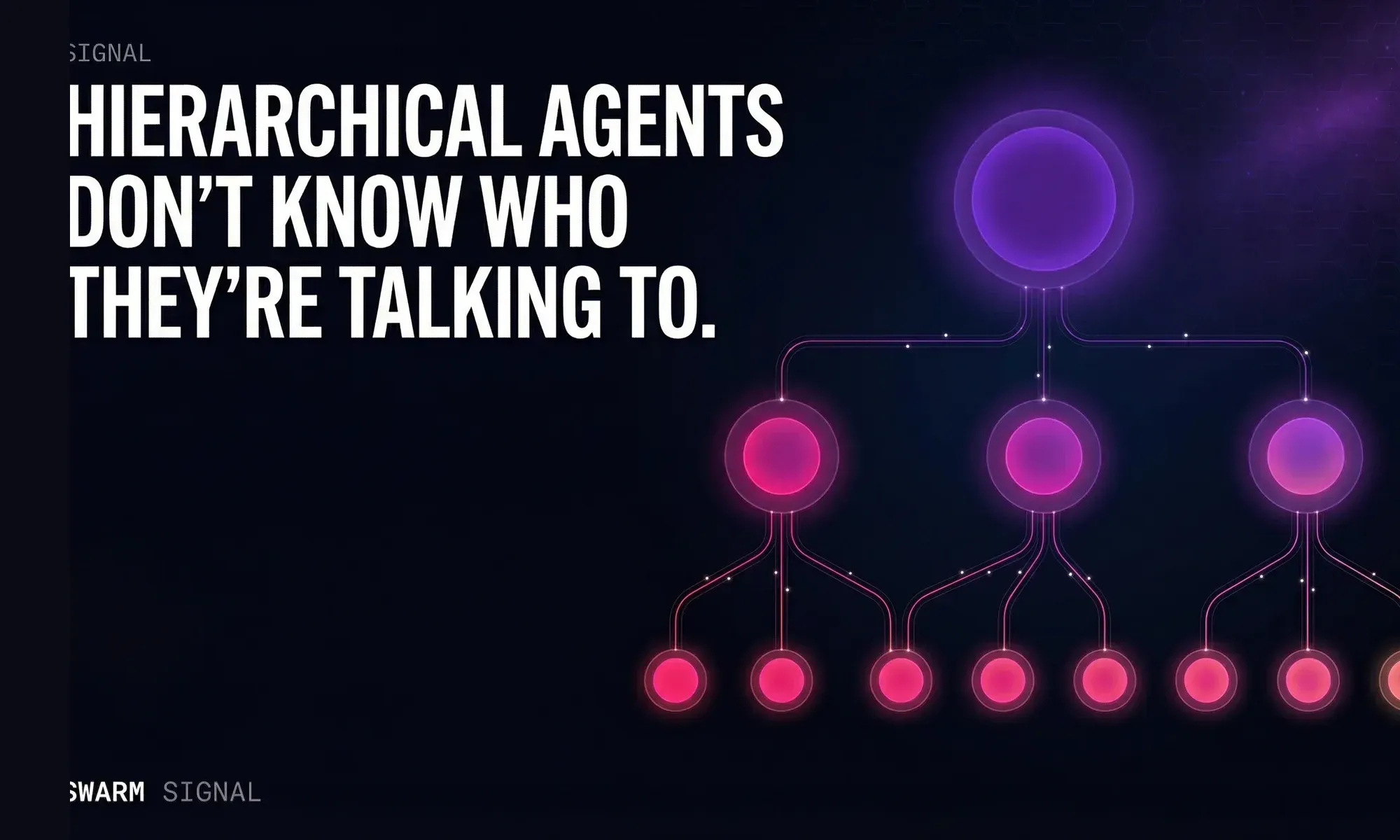
Hierarchical agent architectures have gotten genuinely good at task decomposition. A manager agent breaks a goal into subtasks, dispatches them to specialized workers, collects results, and synthesizes an answer. The Kawabe and Takano paper on multi-robot task planning shows this working cleanly in a heterogeneous robotics context: an LLM-based planner generates natural-language instructions, a prompt optimization layer translates them into executable actions, and the whole thing beats conventional PDDL planners on multi-step tasks without manual domain definition. That's a real result.
But watch what happens when you ask that system to do something for a specific person. The planning layer doesn't have a user model. The worker agents don't carry user preferences downstream. The synthesizer at the top is working with task outputs, not with any persistent sense of who issued the original request or why their context matters. The hierarchy solves orchestration. It doesn't solve identity.
This is like hiring a team of extremely competent contractors who've never met you, handing them blueprints, and assuming the house will feel like yours when they're done. The work might be excellent. It won't be personal.
What Personalization Actually Requires
The Chang et al. paper on graph-empowered LLMs for proactive information access frames the problem more honestly than most. They're building a lifelog recall system, something that helps users retrieve forgotten personal experiences, and they call out a critical constraint upfront: people struggle to recall all life details and often confuse events, which means the system can't just retrieve facts, it has to model the user's own unreliable relationship to their history.
That's not a search problem. It's a modeling problem. And it's one that gets dramatically harder when you introduce a multi-agent layer between the user and their stored context. Each agent in a hierarchy is a potential lossy compression step. The manager agent summarizes for the worker. The worker summarizes its result for the manager. By the time a personalized preference signal has traveled down three tiers and come back up, it's often unrecognizable. We've covered this pattern before in the context of how memory degrades across agent hops, and it's only getting worse as hierarchies get deeper.
The Pancake memory paper makes this structural problem explicit. In multi-agent LLM serving, KV cache sharing across agent layers is where personalization signals typically get evicted first. The system optimizes for token efficiency, not for user-specific context preservation. You can't build a persistent user identity on memory infrastructure that treats personal context as evictable overhead.
Where Hierarchy Helps, And Where It Breaks
The Eckel and Meeß paper on Hierarchical Lead Critic MARL offers a useful frame for thinking about where in a hierarchy you should inject personalization. Their architecture inserts a hierarchical critic that evaluates actions at multiple levels of abstraction simultaneously, not just at the leaf agent level. The result is better coordination on cooperative tasks because agents receive gradient signal that reflects system-level consequences, not just local rewards.
Translate that to personalized LLM agent stacks and the implication is direct: if you want user preference to influence behavior, you can't inject it only at the task input level and hope it propagates. You need something analogous to a hierarchical critic, a user-modeling layer that evaluates outputs at each tier for personalization fidelity, not just task accuracy. That's architecturally non-trivial. Most production systems don't have it.
The geoscience discovery paper from Pantiukhin et al. illustrates the deployment reality. Their hierarchical multi-agent system for autonomous scientific data discovery works well when the task objective is well-defined and shared. It falls apart when different researchers have different notions of relevance, which is always. They handle this by externalizing the preference specification, asking users to write structured queries. That's a reasonable workaround. It's not personalization. It's structured search with a natural language frontend.
The Memory Architecture Problem
I've tracked this issue across at least six different multi-agent papers in the past two months, and the pattern is consistent: teams nail the coordination layer, then treat memory and user context as a feature to bolt on later. It never bolts on cleanly.
The structural issue is that hierarchical agent architectures create communication bottlenecks that are hostile to rich context propagation. Manager agents receive compressed summaries from workers, not raw reasoning traces. Workers receive task descriptions from managers, not full user histories. The compression is necessary for efficiency, but it systematically discards the high-dimensional personal context that makes a response feel tailored rather than generic. The retrieval side of this equation, where agents pull context back in from external stores, is evolving fast; agentic RAG architectures are one attempt to solve it, but they're still largely designed for document retrieval rather than user modeling.
Pancake's hierarchical memory system addresses this at the infrastructure level by distinguishing between shareable KV cache blocks and user-specific context blocks that shouldn't be evicted under memory pressure. That's the right framing. But it requires memory tier awareness baked into the serving infrastructure, not just the model layer, which creates a coordination problem between ML engineers and systems engineers that most teams haven't resolved.
The Chang et al. graph approach is interesting here because it externalizes personal context into a structured knowledge graph that any agent in the hierarchy can query directly, rather than relying on context propagation through the message chain. Each agent gets user context on demand rather than receiving it as a compressed handoff from its parent. That sidesteps the lossy compression problem, at the cost of requiring a maintained, queryable personal knowledge graph, which itself requires continuous updates as the user's context evolves. It's not free. Nothing is.
What the Headlines Miss
The framing you'll see on hierarchical multiagent systems is almost always about capability scaling: more agents, more specialization, better task performance. The Kawabe robotics result, the geoscience discovery paper, the MARL coordination improvements, these are real, and they're good results. The coordination layer has matured.
But there's a paper I'd want to see that nobody's written yet: a systematic evaluation of how much personalization signal survives n tiers of hierarchical agent communication. My bet is the degradation curve is steep and most teams are underestimating it. The standard evaluation benchmarks don't measure this. They measure task completion, not user satisfaction, and those diverge the moment the task involves any personal context.
The SemVideo paper, which reconstructs visual experience from brain activity using hierarchical semantic guidance, is technically in a different domain, but it illustrates a relevant point: hierarchical semantic decomposition preserves high-level meaning but loses fine-grained subjective texture at each abstraction step. That's exactly the problem you get in personalized agent hierarchies. The task gets done. The personal texture gets averaged away.
What This Actually Changes
The current generation of hierarchical multiagent work has earned its results on coordination. Decomposing complex tasks, managing heterogeneous agent pools, optimizing communication, these are solved or near-solved problems for constrained domains. What hasn't been solved is making the hierarchy aware that it's serving a specific person with a specific history, not just completing a category of task.
This matters practically for anyone building production agent systems. If your architecture routes user requests through multiple LLM tiers before generating a response, you should assume that user-specific context is degrading at each hop unless you've explicitly designed against that. That means either externalizing personal context into a queryable graph that agents access directly, building a hierarchical critic that evaluates personalization fidelity at each tier, or accepting that your "personalized" system is actually a well-coordinated generic system with a user-specific input layer. The overhead costs of these additional layers are real, and they compound with hierarchy depth, a dynamic we've examined in LLM-powered swarm architectures where coordination costs already dominate.
The third option is what most deployed systems are running right now. That's the gap. The research community is starting to address it from multiple directions simultaneously, memory infrastructure, graph-based user modeling, hierarchical critic architectures, but there's no unified answer yet, and the benchmark infrastructure to measure progress doesn't exist in any standard form.
Build the coordination layer. Don't assume personalization comes with it. It doesn't.
Sources
Research Papers:
- Personalized Graph-Empowered Large Language Model for Proactive Information Access, Chia Cheng Chang, An-Zi Yen, Hen-Hsen Huang et al. (2026)
- Hierarchical Lead Critic based Multi-Agent Reinforcement Learning, David Eckel, Henri Meeß (2026)
- Hierarchical LLM-Based Multi-Agent Framework with Prompt Optimization for Multi-Robot Task Planning, Tomoya Kawabe, Rin Takano (2026)
- A Hierarchical Multi-Agent System for Autonomous Discovery in Geoscientific Data Archives, Dmitrii Pantiukhin, Ivan Kuznetsov, Boris Shapkin et al. (2026)
- Pancake: Hierarchical Memory System for Multi-Agent LLM Serving, Zhengding Hu, Zaifeng Pan, Prabhleen Kaur et al. (2026)
- SemVideo: Reconstructs What You Watch from Brain Activity via Hierarchical Semantic Guidance, Minghan Yang, Lan Yang, Ke Li et al. (2026)
Industry / Case Studies:
- Multi-Agent Systems Overview, Lilian Weng, OpenAI
- Papers With Code: Multi-Agent Reinforcement Learning, Papers With Code
Related Swarm Signal Coverage: