

Agent Design
How you actually build AI agents that work. Architectures, tool use, memory patterns, and the frameworks worth paying attention to.
Guides and explainers
Detailed guides and practical technical analysis.
Latest analysis
Recent research, benchmark reviews and technical updates.
Practical tools
Templates for budgets and project planning
BoredTools offers practical spreadsheets for budgets, freelance work and small projects.

Tool Agents Need Taint Boundaries, Not Bigger Scopes
APPA landed on arXiv on 27 July 2026 with a blunt result for tool-agent security: permission prompts are too late once poisoned or confidential data has...

Terminal Agents Need Progress Curves, Not Victory Screens
Long-Horizon-Terminal-Bench landed on arXiv in July 2026 with an awkward result for terminal-agent buyers: even the strongest tested model still failed...

Agent Observability Is Escaping the Dashboard
Agent observability is moving from vendor dashboards into trace contracts that make every model call, tool call, handoff, guardrail, and evaluator step inspectable.

Agent Evals Need Harnesses, Not More Scoreboards
AgentCompass first landed on arXiv on 15 July 2026 with a practical complaint: agent evaluation is fragmented, tightly coupled, and hard to reproduce...

Self-Improving Agents Have an Evaluator Problem
Anthropic's June 2026 update on recursive self-improvement is not a distant sci-fi warning. The company says its engineers now ship 8x as much code per...

The Agent Project That Should Have Been One LLM Call
Some enterprise agent projects fail because autonomy was added where a bounded single-call LLM design would have delivered cleaner behavior and lower operational risk.
Tool-Use Agents Need Failure Labels, Not Pass Rates
Tool-use agents can fail in ways a final accuracy score hides, because the same wrong answer can come from skipped tools, ignored outputs, fabricated...

Agent Observability Needs Provenance, Not More Logs
Agent observability is drifting toward a familiar trap: capture every trace, then ask an engineer to work out why the agent did the wrong thing. A June...

Agent Leaderboards Can Be Cheaper Without Being Safer
A March 2026 paper on efficient agent benchmarking found that mid-difficulty task subsets can remove large parts of an agent benchmark while preserving...
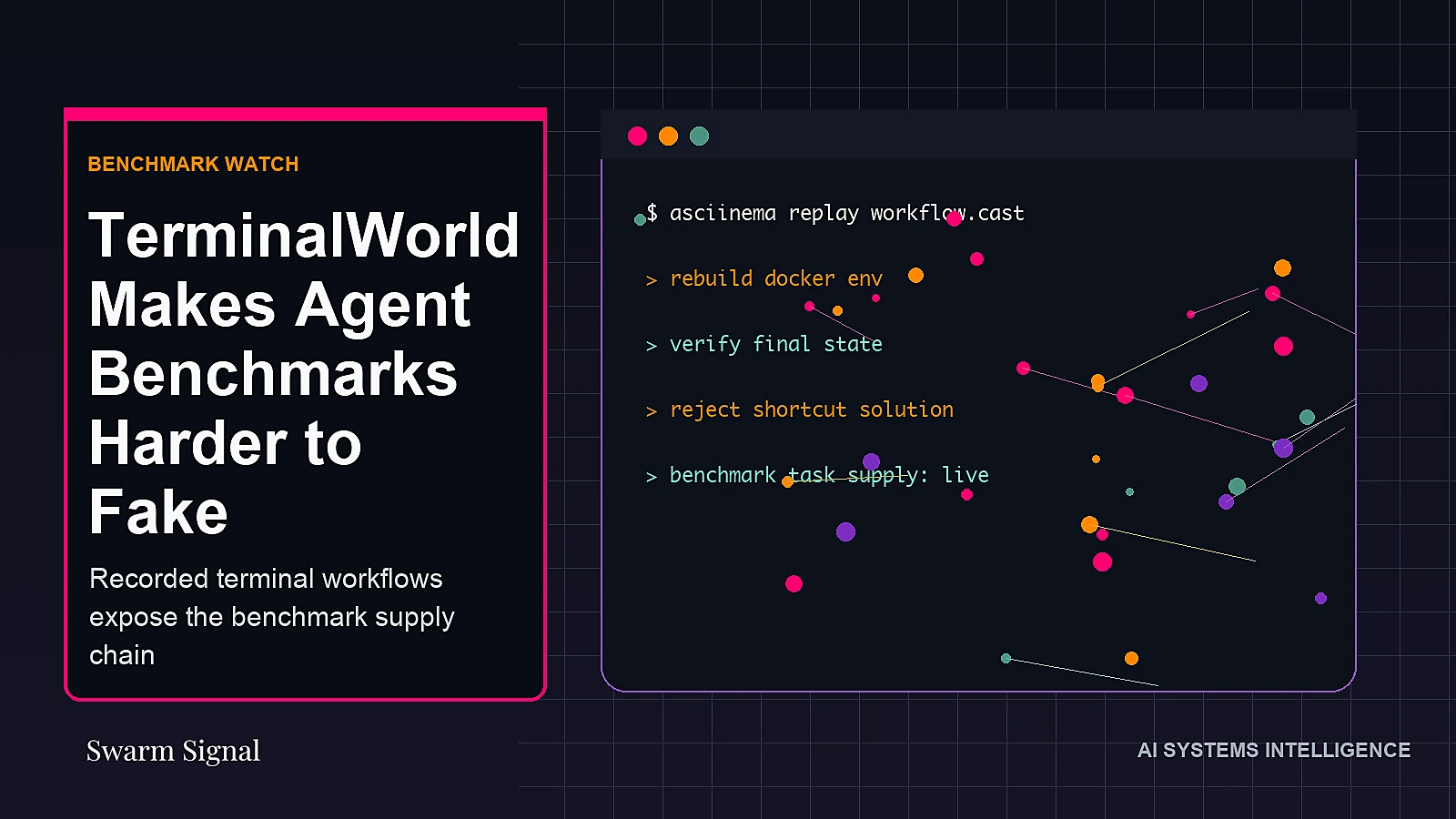
TerminalWorld Makes Agent Benchmarks Harder to Fake
TerminalWorld turns public terminal recordings into validated agent tasks. The signal is not a higher leaderboard score. It is a harder benchmark supply chain.