

▶️ LISTEN TO THIS ARTICLE
The entire AI industry is converging on agents. Anthropic, Moonshot, and OpenAI are all racing to build more autonomous, capable systems. But while the big labs focus on the “brains,” a quiet, open-source project called OpenClaw has been building the “body” — and in doing so, it may have just kickstarted an agent revolution.
OpenClaw, which went viral in late January 2026 after a few name changes (you may have known it as Clawdbot or Moltbot), is not just another AI assistant. It’s a framework that gives agents “hands.” It connects to your chat apps, has access to your operating system (terminal, files, browser), and can be extended with over 5,700 community-built skills via the ClawHub registry. It’s the difference between a calculator and a computer.
But the real innovation is what its creator, Peter Steinberger, calls the “heartbeat.” Unlike passive models that wait for a prompt, OpenClaw agents operate on a proactive loop. They wake up, scan their environment, and get to work — summarizing emails, checking crypto prices, or even deploying smart contracts, all without human intervention. This shift from passive tool to active system is a fundamental leap toward true autonomy.
"The real innovation is the 'heartbeat.' Unlike passive models that wait for a prompt, OpenClaw agents operate on a proactive loop. They wake up, scan their environment, and get to work."
The Body of the Agent Economy
For months, the crypto space has been building the individual organs of an agent economy: decentralized identity (ERC-8004), per-request payments (x402), and on-chain reputation. These are the essential building blocks for machines to transact and coordinate with each other. But they were organs without a body.
OpenClaw provides that body. Its open-source, extensible, and sovereign nature aligns perfectly with the ethos of crypto. With the recent release of version 2026.2.2, the framework introduced a dedicated Memory Plugin, effectively giving the "body" a persistent nervous system. This mirrors the memory architecture challenges facing long-horizon agents, where the ability to act is only as good as the ability to remember and transact.
"Agents can now not only act autonomously but also transact autonomously. They can pay for services, hire each other, and build financial standing."
We’re already seeing this in action. An agent named Langoustine69, built on OpenClaw, shipped over 80 paid x402 endpoints in a single week, offering services from DeFi analytics to earthquake monitoring. This is a functioning, agent-native service economy, albeit at a micro scale. It’s a world where agents are not just tools, but economic actors, similar to how reasoning tokens are shifting models from mere responders to active thinkers.
The Contrarian Take: Autonomy vs. Security
While the viral hype around OpenClaw has focused on its impressive capabilities, the real story is more nuanced. The project’s rapid rise also exposed its security flaws. As of February 9, 2026, reports indicate over 40,000 exposed OpenClaw instances on the public internet, with more than 12,000 vulnerable to Remote Code Execution (RCE).
The very "vibe coding" culture that made OpenClaw accessible is now its greatest liability. China has issued formal warnings, and CrowdStrike hosted a global broadcast warning that OpenClaw represents "a new class of security risk" due to unsecured automation at scale. This is the messy reality of building in the open: autonomy without security is not sovereignty; it's a vulnerability.
"While the big labs focus on the 'brains,' a quiet, open-source project called OpenClaw has been building the 'body' — and in doing so, it may have just kickstarted an agent revolution."
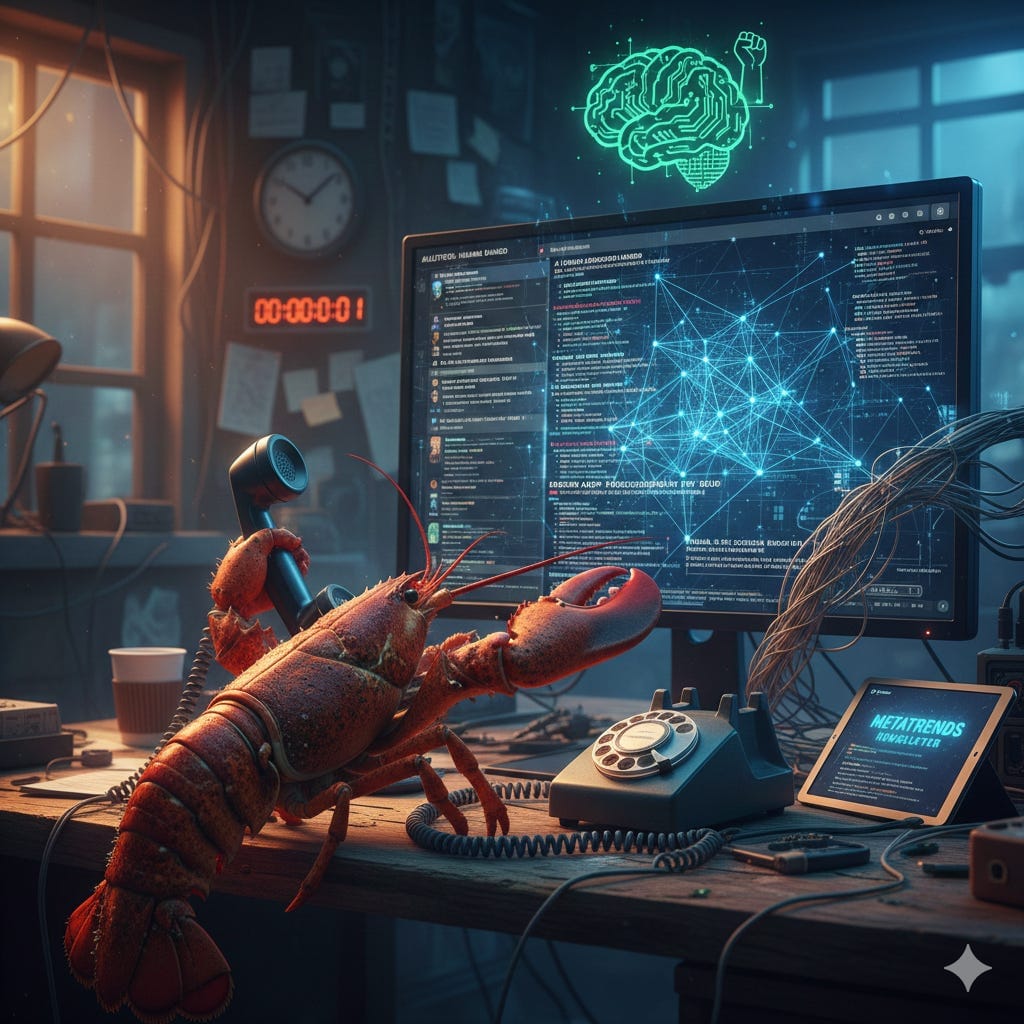
The real story of OpenClaw isn’t about a single, flawless piece of technology. It’s about the convergence of two powerful forces: the drive for AI autonomy and the need for a permissionless, economic layer for that autonomy to flourish. OpenClaw, with all its flaws and all its promise, is the lobster in the machine, the ghost in the shell — the first real body for the coming agent economy.
References
- [1] "OpenClaw and the Body of the Agent Economy," Bankless, Feb 2026. https://www.bankless.com/read/openclaw-and-the-body-of-the-agent-economy
- [2] "Over 40,000 OpenClaw agents vulnerable," Techzine, Feb 9, 2026. https://www.techzine.eu/news/security/138633/over-40000-openclaw-agents-vulnerable/
- [3] "China warns of security risks linked to OpenClaw," Reuters, Feb 5, 2026. https://www.reuters.com/world/china/china-warns-security-risks-linked-openclaw-open-source-ai-agent-2026-02-05/
- [4] "OpenClaw just shipped another update: Memory Plugin and ClawHub growth," Community Registry, Feb 7, 2026.
- [5] "CVE-2026-25253 in Internet-Facing AI Agent Gateways," Hunt.io, Feb 2026. https://hunt.io/blog/cve-2026-25253-openclaw-ai-agent-exposure
- [6] "What Security Teams Need to Know About OpenClaw," CrowdStrike, Feb 2026. https://www.crowdstrike.com/en-us/blog/what-security-teams-need-to-know-about-openclaw-ai-super-agent/
Sources
Research Papers & Technical Documentation:
- OpenClaw Architecture, Explained -- Paolo Perazzo (2026)
- Deep Dive into OpenClaw Architecture: Technical Principles and Extension Practices of the Three-Layer Design -- BetterLink Blog (2026)
- OpenClaw Architecture Guide | High-Reliability AI Agent Framework -- Vertu (2026)
- OpenClaw AI Wiki: Architecture, Skills, and Implementation -- WiTechpedia
Industry & Security Analysis:
- What Security Teams Need to Know About OpenClaw, the AI Super Agent -- CrowdStrike (2026)
- OpenClaw proves agentic AI works. It also proves your security model doesn't -- VentureBeat (2026)
- Personal AI Agents like OpenClaw Are a Security Nightmare -- Cisco Blogs (2026)
- OpenClaw Security: Risks of Exposed AI Agents Explained -- Bitsight (2026)
- 135K OpenClaw AI Agents Exposed to Internet -- Bitdefender (2026)
- New OpenClaw AI agent found unsafe for use -- Kaspersky (2026)
Commentary & Analysis:
- What is OpenClaw? Your Open-Source AI Assistant for 2026 -- DigitalOcean (2026)
- OpenClaw Review: The AI Assistant Taking the World by Storm -- Unite.AI (2026)
- The human hardware: Understanding OpenClaw and the agentic economy -- Calcalist Tech (2026)
- NanoClaw solves one of OpenClaw's biggest security issues -- VentureBeat (2026)
Official Resources:
- GitHub: openclaw/openclaw -- OpenClaw Project
- OpenClaw — Personal AI Assistant -- Official Website
- OpenClaw Documentation: Lobster -- OpenClaw Docs
Related Swarm Signal Coverage: