

▶️ LISTEN TO THIS ARTICLE
The best AI agents today succeed on only 62.3% of real-world tool-use tasks. That number comes from MCP-Atlas, a benchmark testing agents against 36 production tool servers and 220 actual APIs. Even Claude Opus 4.5, the current leader, fails more than a third of the time. The problem isn't that agents lack access to tools. It's that they haven't learned how to think about tools.
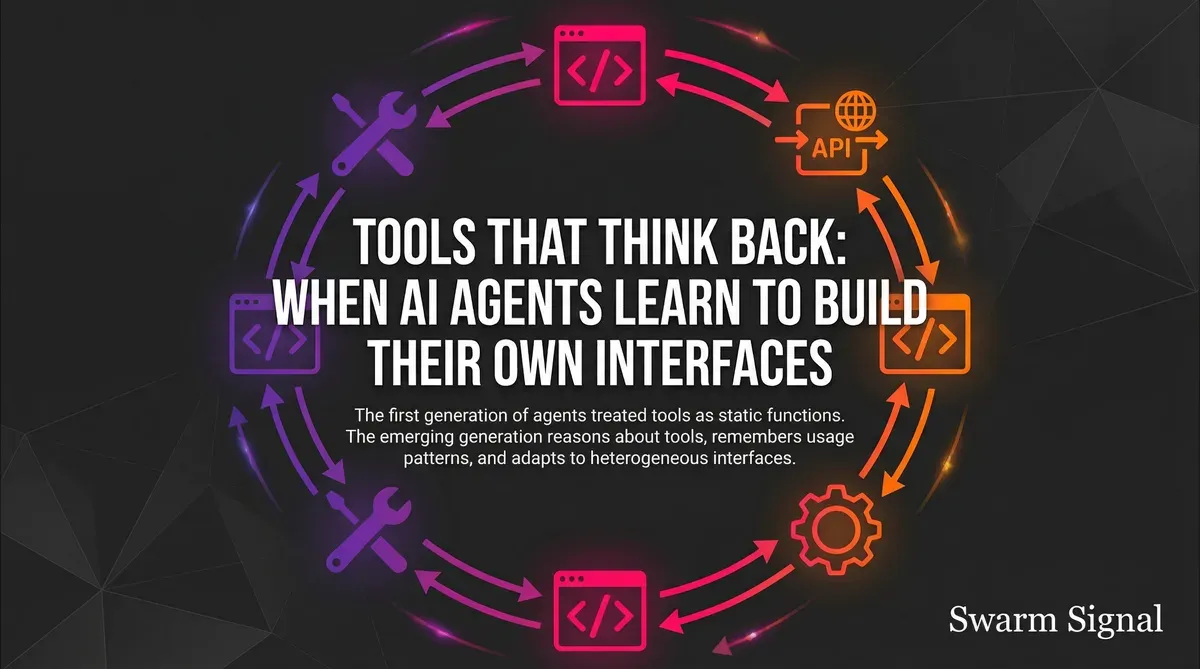
We're entering a phase shift in agent architecture. The first generation of agents treated tools as static functions: call this API, get that result. The emerging generation is different. These agents learn which tools to trust, when to compose capabilities, and how to reason explicitly about tool selection itself. Tools are becoming dynamic, learned capabilities rather than fixed interfaces. And the tools are starting to think back.
The Reasoning Layer
Function calling has traditionally been a pattern-matching exercise: parse the user intent, map it to a function signature, execute. But Anthropic researchers recently demonstrated that adding a single "think" parameter to every function call improves accuracy without any architectural changes. The think-augmented approach embeds explicit reasoning directly into the function-calling process. Before executing a tool, the agent articulates why it's choosing that tool, what it expects to learn, and how it will use the result.
This isn't prompt engineering. It's a structural change in how agents interact with capabilities. When an agent must articulate its reasoning before every tool call, it catches errors early, composes tools more effectively, and builds a trace of its decision-making that can be inspected and improved. The cognitive overhead is minimal, without requiring architectural modifications, and the reliability gains are significant. This reasoning-first approach extends the broader shift toward inference-time computation explored in From Answer to Insight.
The broader implication is that tool use is becoming a reasoning task, not just an execution task. As one recent survey on agentic reasoning notes, tool use sits at the foundational layer of agent cognition, alongside planning and memory. When agents reason about tools explicitly, they move from reactive to deliberative behavior. OpenAI has also improved function calling across three axes: calling relevant functions, calling functions at the appropriate time, and calling functions with appropriate arguments, resulting in substantially higher accuracy in GPT-4 models.
The Protocol Layer
The Model Context Protocol (MCP) is attempting to standardize how agents discover and interact with external capabilities. It's the first serious effort to create a universal tool interface for AI systems. Announced by Anthropic in November 2024 and open-sourced with SDKs for Python and TypeScript, MCP addresses the challenge of information silos and fragmented integrations. But the MCP-Atlas benchmark reveals how far we still have to go. Across 1,000 tasks involving real MCP servers, covering everything from file systems to databases to Slack integrations, even frontier models struggle with composition, error handling, and multi-step workflows.
Part of the challenge is linguistic diversity. Agents trained on synthetic function-calling data often fail when real-world APIs use different naming conventions, parameter structures, or documentation styles. A recent study from Technion and the Technology Innovation Institute (TII) showed that generating training data with deliberately varied linguistic patterns (different function names for the same capability, diverse parameter orderings, varied documentation formats) substantially improves generalization to unseen tools.
The lesson here is that tool interfaces aren't just technical specifications. They're languages. And like human languages, they require exposure to diversity to develop fluency. The future of tool protocols isn't just standardization. It's learning systems that can adapt to heterogeneous interfaces on the fly. By March 2025, OpenAI had officially adopted MCP across its products, and in April 2025, Google DeepMind confirmed MCP support in upcoming Gemini models, signaling that the protocol is becoming an industry standard. Platforms like Apify already publish MCP servers for web scraping and browser automation, expanding the catalog of production-ready tools agents can discover through the protocol.
The Memory Layer
Tools become more powerful when agents remember how to use them. Traditional agents treat every tool call as stateless: here's the function signature, execute it, move on. But newer architectures are exposing memory operations as tools themselves. AgeMem, a reinforcement learning approach from recent work, lets agents learn to store, retrieve, and update knowledge about tool usage patterns.
This creates a feedback loop. An agent discovers that combining two specific tools in sequence produces better results than calling them independently. It stores that pattern in memory. Later, when it encounters a similar task, it retrieves the pattern and adapts it. Over time, the agent builds a repertoire of tool-use strategies that go beyond what its training data provided. This feedback loop connects to the broader challenge of agent memory. The Goldfish Brain Problem explores why most architectures still struggle with long-horizon recall.
Memory also enables agents to learn from failure. When MCP-Atlas agents fail a task, the most common reasons are incorrect tool sequencing, missing error handling, and misunderstanding tool preconditions. These aren't fundamental capability gaps. They're learnable patterns. An agent with memory can recognize "I failed this way before" and adjust its strategy. As noted in recent work on robust real-world adaptation, current agent evaluations tend to overestimate readiness precisely because they don't test learning under noisy, partially observable conditions.
Toward Adaptive Interfaces
The endgame isn't just smarter agents. It's smarter interfaces between agents and tools. Recent work on SYMPHONY demonstrates this by integrating multiple specialized agents with different reasoning styles into a unified planning system. One agent might excel at database queries, another at API composition, a third at error recovery. The system learns which agent to route tasks to using adaptive scheduling algorithms borrowed from multi-armed bandit problems.
This points toward a future where tool interfaces themselves become adaptive. Rather than presenting every agent with the same static API, interfaces could adjust their complexity, verbosity, and structure based on the agent's demonstrated capabilities. A novice agent gets more explicit documentation and guardrails. An experienced agent gets direct access to composable primitives. The interface learns from the agent, and the agent learns from the interface. Anthropic has introduced features like Programmatic Tool Calling, which allows Claude to orchestrate tools through code execution environments rather than through individual API round-trips, reducing context window consumption and improving multi-tool workflows.
We're still early. A 62.3% success rate means production deployments need extensive human oversight, fallback mechanisms, and careful task scoping, the friction documented in When Agents Meet Reality. Engineering leaders cite quality and reliability as a top challenge, with 32% of organizations identifying these as primary barriers to production deployment. TheAgentCompany benchmarks show leading agents complete only 30-35% of multi-step tasks, making reliability engineering a critical differentiator. But the trajectory is clear. Agents are moving from executing tools to reasoning about tools, from static interfaces to learned capabilities, from one-shot calls to iterative refinement. The tools are thinking back. And that changes everything.
Sources
Research Papers:
- MCP-Atlas: A Benchmark for Real-World Tool-Use Tasks
- Think-Augmented Function Calling for Improved Tool Use
- Survey on Agentic Reasoning and Tool Use
- Linguistic Diversity in Tool Interface Training
- AgeMem: Reinforcement Learning for Tool Memory
- Robust Real-World Agent Adaptation
- SYMPHONY: Multi-Agent Planning Systems
Industry / Case Studies:
- Introducing the Model Context Protocol — Anthropic
- Introducing Advanced Tool Use — Anthropic
- Function Calling and Other API Updates — OpenAI
- Model Context Protocol Specification — MCP
- Connect to External Tools with MCP — Claude API Docs
Commentary:
- Why the Model Context Protocol Won — The New Stack
- State of Agent Engineering — LangChain
- AI Agents in Production 2025 — Cleanlab
Related Swarm Signal Coverage: