LISTEN TO THIS ARTICLE
Why Multi-Agent Papers Don't Replicate in Production
A paper from Tran and Kiela tested 28 multi-agent configurations across four architectures: Sequential, Parallel, Debate, and Ensemble. Every single one performed worse than a single agent given the same token budget. The degradation ranged from -4.4% to -35.3%. DeepSeek scored 0.448 as a single agent on FRAMES but dropped to 0.391 in multi-agent mode. On MuSiQue 4-hop reasoning, the gap widened further: 0.407 solo versus 0.320 with collaborators.
This isn't an isolated finding. It's the clearest statement yet of a pattern practitioners have suspected for two years: the multi-agent results published in papers rarely survive contact with production constraints. The question is why.
The Missing Baseline Problem
Nature Machine Intelligence published an editorial in 2026 calling for mandatory single-agent baselines in all multi-agent papers. The reason: most papers lack them. Researchers build elaborate multi-agent architectures, report absolute performance numbers, and never answer the obvious question: would a single agent with the same compute budget do better?
When someone finally asks that question systematically, the answer is usually yes. The Tran and Kiela study controlled for total token consumption, something almost no prior multi-agent paper bothered to do. Under equal budgets, single-agent latency ran 2-4 seconds. Multi-agent latency: 8-15 seconds. Monthly costs: $500-$1,500 for single agents versus $1,500-$5,000 for equivalent multi-agent workloads. The multi-agent system didn't just perform worse. It performed worse while costing more and running slower.
This isn't a flaw in multi-agent systems. It's a flaw in how we evaluate them. Papers report peak performance under optimal conditions with unlimited compute. Production enforces token budgets, latency requirements, and cost constraints. The moment you apply those constraints, the coordination tax eats the capability gains.
Why Papers Look Better Than Production
Three factors inflate published multi-agent results beyond what production can reproduce.
Cherry-picked benchmarks. Multi-agent papers gravitate toward tasks where decomposition helps. Code generation with test verification. Research synthesis across many documents. Debate-style reasoning on ambiguous questions. These tasks genuinely benefit from multiple perspectives. But they represent a narrow slice of production workloads. Customer support, data extraction, document processing, and workflow automation don't decompose as cleanly. Galileo's benchmark analysis found that only 4 of 15 active agent benchmarks reliably predict production outcomes. Agent performance drops from 60% on single runs to 25% when measured across 8 consecutive runs for consistency.
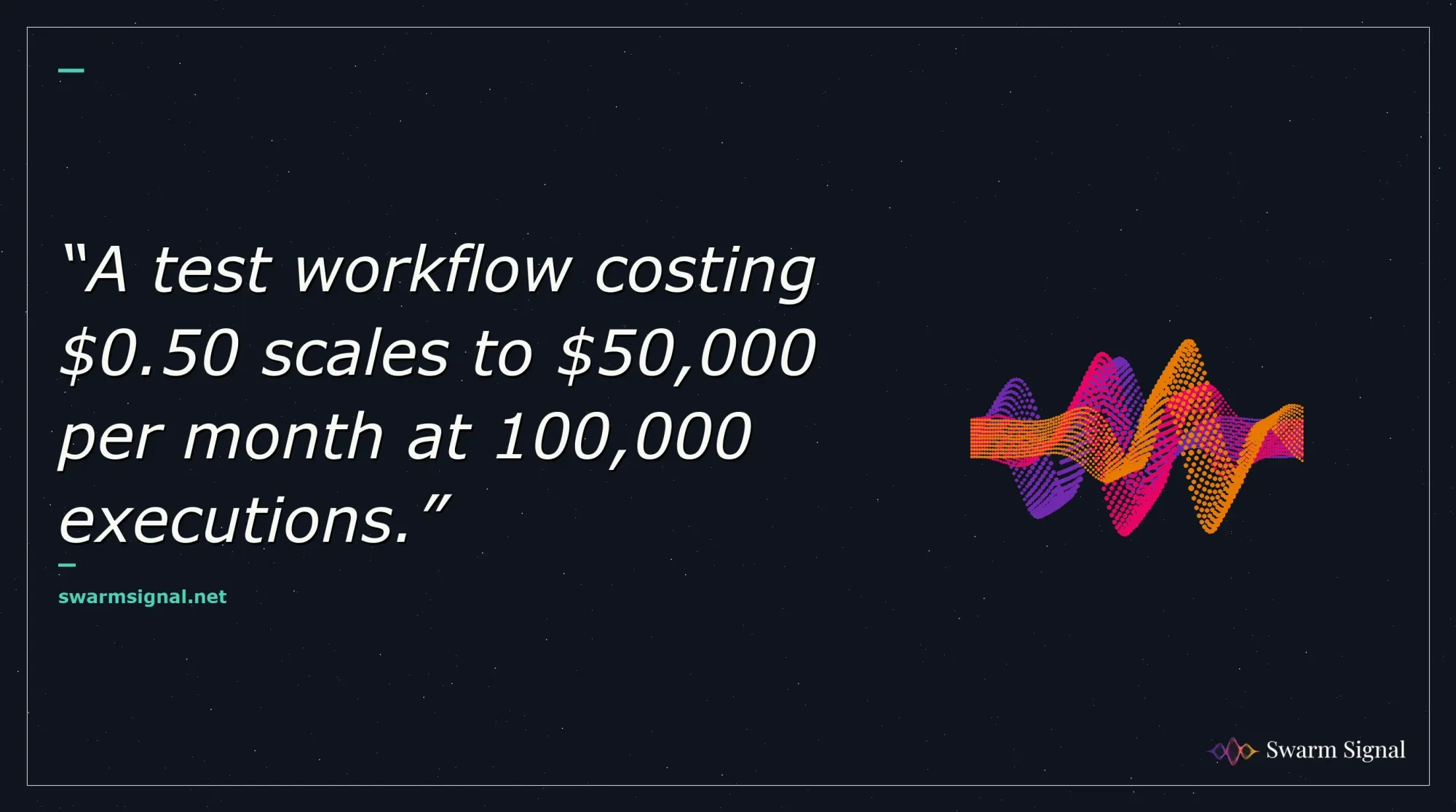
Hidden compute costs. Centralized orchestration adds 285% token overhead compared to single-agent execution. A test workflow costing $0.50 scales to $50,000 per month at 100,000 executions. Papers report task completion rates. They don't report cost-per-completion or tokens-per-successful-outcome. When enterprises run the real math, multi-agent architectures that looked promising in papers become economically unviable.
Controlled environments. Research benchmarks provide clean inputs, deterministic tool responses, and predictable failure modes. Production means malformed user inputs, flaky APIs, partial failures, and cascading timeouts. ICLR 2025 research categorized production multi-agent failures into four types: specification ambiguities, organizational breakdowns, inter-agent conflict, and weak verification. None of these show up in benchmark conditions. A Digital Applied survey of 650 enterprise tech leaders found that only 14% successfully scale agents to production despite 78% running pilots. Gartner reports 40% of multi-agent pilots fail within six months of deployment.
The Exception That Proves the Rule
Multi-agent systems do work when tasks are embarrassingly parallel. Literature search across 50 papers. Independent data extraction from separate sources. Parallel code testing across multiple environments. When agents don't need to coordinate, they don't pay coordination costs, and multi-agent becomes a straightforward scaling strategy.
A hybrid cascading approach that starts with a single agent and only escalates to multi-agent on failures improved accuracy by 1.1-12% while cutting costs 20%. This is the architecture that actually respects production constraints: default to simple, escalate to complex only when simple fails.
What This Changes
The replication gap isn't just an academic concern. It's distorting investment decisions. Teams read multi-agent papers, build multi-agent systems, and then spend months discovering what controlled experiments already showed: a single agent with good tools beats a team of agents with shared confusion.
Nature's call for mandatory single-agent baselines is the minimum viable fix. Papers should also report cost-per-completion, measure consistency across runs rather than peak performance, and test under realistic failure conditions. Until those standards become normal, treat published multi-agent results the way you'd treat any benchmark number: as a ceiling you will never hit in production, published by people whose incentives are to make the ceiling look high.
The practical takeaway is simpler than the research. Start with one agent. Give it good tools. Measure whether it solves your problem. Only add agents when you have evidence, not intuition, that decomposition helps. The coordination tax is real, the replication gap is widening, and no paper has repealed Brooks's Law yet.
Sources
- Tran & Kiela, "Single-Agent LLMs Outperform Multi-Agent," arXiv 2604.02460 (April 2026)
- Nature Machine Intelligence, "Multi-agent AI systems need transparency" (2026)
- Galileo, "Benchmarks for Multi-Agent AI" (2026)
- Digital Applied, "AI Agent Scaling Gap" (March 2026)
- Iterathon, "Multi-Agent Orchestration Economics" (2026)
- ICLR 2025, "Why Do Multiagent Systems Fail?"
- arXiv 2505.18286, "Single-agent or Multi-agent? Why Not Both?" (2025)