

Practical tools
Templates for planning work and money
BoredTools offers practical spreadsheets for budgets, freelance work and small projects.

Agent Observability Needs Provenance, Not More Logs
Agent observability is drifting toward a familiar trap: capture every trace, then ask an engineer to work out why the agent did the wrong thing. A June...
Scaling Laws Explained for Practitioners: What Actually Matters in 2026
Scaling laws promised a simple deal: spend more compute, get better models. For three years, that deal held. Kaplan et al. drew the first power-law curves...

Agent Leaderboards Can Be Cheaper Without Being Safer
A March 2026 paper on efficient agent benchmarking found that mid-difficulty task subsets can remove large parts of an agent benchmark while preserving...

Multi-Agent Systems Need Specs Before More Agents
Multi-agent systems are getting easier to assemble and harder to trust. A new June 2026 paper from Cisco researchers argues that the missing layer is not...

Multimodal Memory Tests Expose the Personal-Agent Gap
Product teams are turning memory into the selling point for personal agents. The hard question is no longer whether they can remember a preference; it is...

Power Grid Agents Need Constraint Tests, Not Chat Scores
A June 2026 power-systems benchmark argues that language-model agents can solve grid-engineering tasks, but the useful signal is narrower: the agent must...
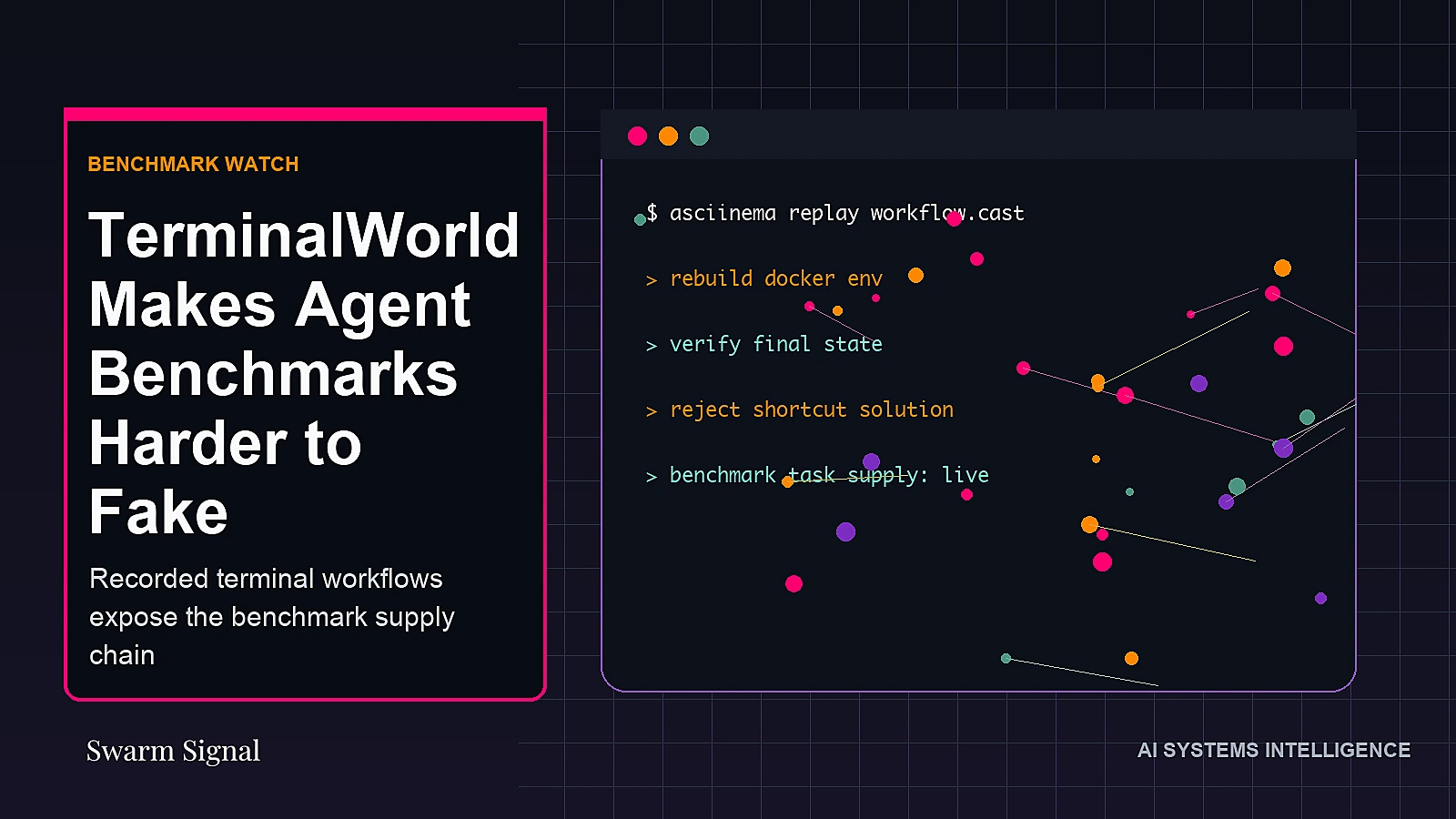
TerminalWorld Makes Agent Benchmarks Harder to Fake
TerminalWorld turns public terminal recordings into validated agent tasks. The signal is not a higher leaderboard score. It is a harder benchmark supply chain.

Agent Tool Menus Are a Safety Surface
New agent benchmarks suggest the visible tool menu is not a neutral implementation detail. It changes success, cost, wrong-tool calls, and risk exposure.
Agent Memory Fails on Relationships, Not Recall
New June 2026 memory benchmarks show why long-running agents fail when facts conflict, evolve, or depend on hidden relationships.
Agent Benchmarking Doesn't Need Every Task
Efficient agent benchmarking points to a cheaper way to compare agents: run the tasks that still separate systems, not every task in the suite.