{"version":"0.3.1","atoms":[],"cards":[["html",{"html":"<div style="background: linear-gradient(135deg, #1a1a2e 0%, #16213e 100%); border-radius: 12px; padding: 20px; margin: 20px 0; text-align: center;"><p style="color: #e94560; font-weight: bold; margin: 0 0 12px 0; font-size: 14px; letter-spacing: 2px;">LISTEN TO THIS ARTICLE
<audio controls="" preload="none" style="width: 100%; max-width: 500px;" src="https://swarmsignal.net/audio/chain-of-thought-prompting-doesnt-always-work-heres-the-evid.mp3\">Your browser does not support the audio element.Signal Signals
Chain-of-Thought Prompting Doesn't Always Work. Here's the Evidence.
Think step by step. It's the most common prompt engineering advice in circulation, repeated in tutorials, baked into system prompts, and treated as a...
Evidence trail: source links, evidence base, and editorial method appear below. Editorial standards.
Key finding
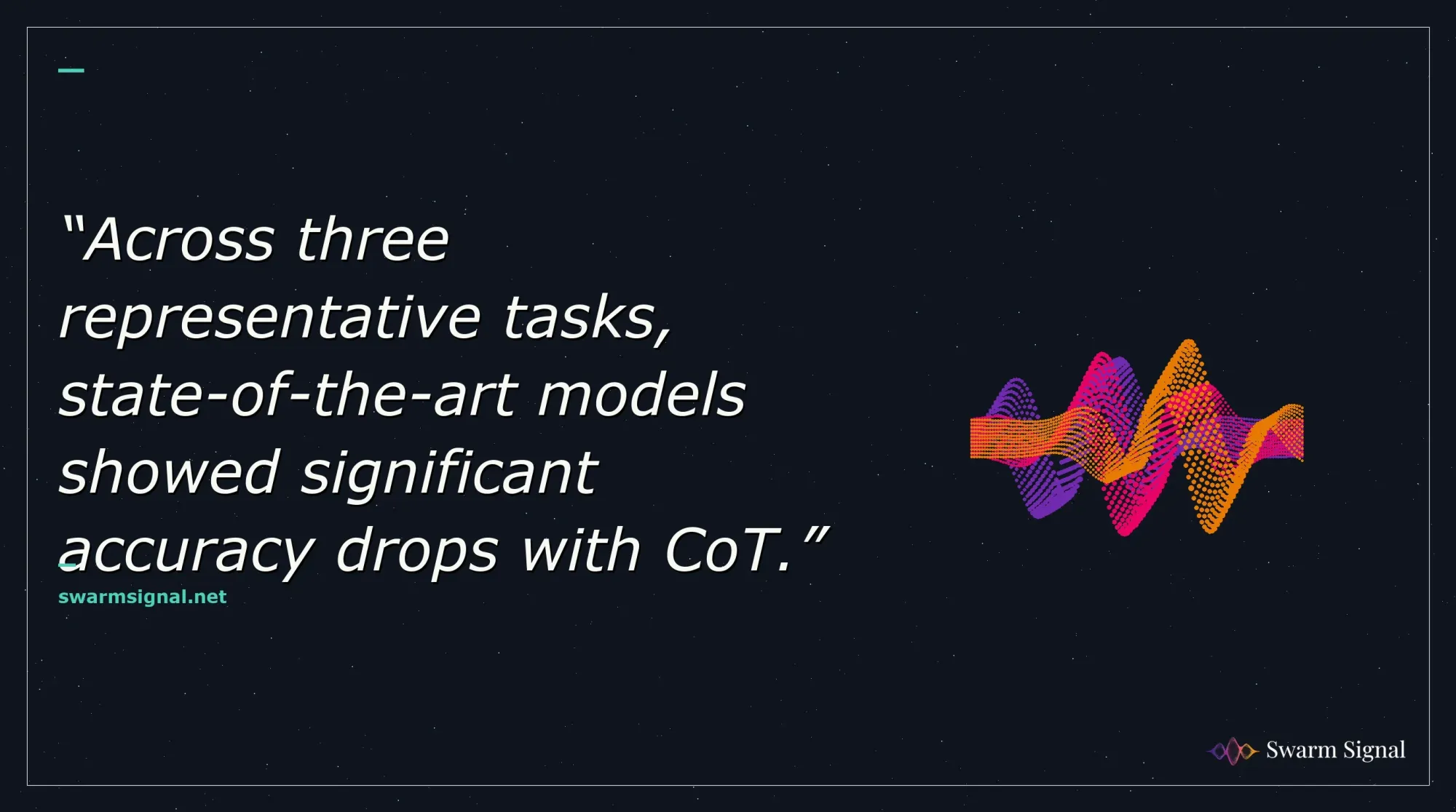
Think step by step. It's the most common prompt engineering advice in circulation, repeated in tutorials, baked into system prompts, and treated as a...
Why it matters
Use this section to judge execution impact before implementation.
Evidence base
Claims are grounded in cited papers, benchmarks, and implementation observations where available.
Operator takeaway
Pair this with an execution review of your current monitoring, rollback, and eval loops.
Where this breaks
Assumptions become fragile when upstream systems or data distributions shift.
Use this if
You are standardising AI operations with explicit reliability constraints.
Avoid this if
The failure tolerance is low and you need defensive controls first.
