

🎧 LISTEN TO THIS ARTICLE
The numbers keep arriving, and they keep saying the same thing. S&P Global's 2025 Voice of the Enterprise survey of 1,006 IT and business leaders found that 42% of companies abandoned the majority of their AI initiatives before reaching production, up from 17% in 2024. The average organization scrapped 46% of proof-of-concepts between pilot and broad adoption.
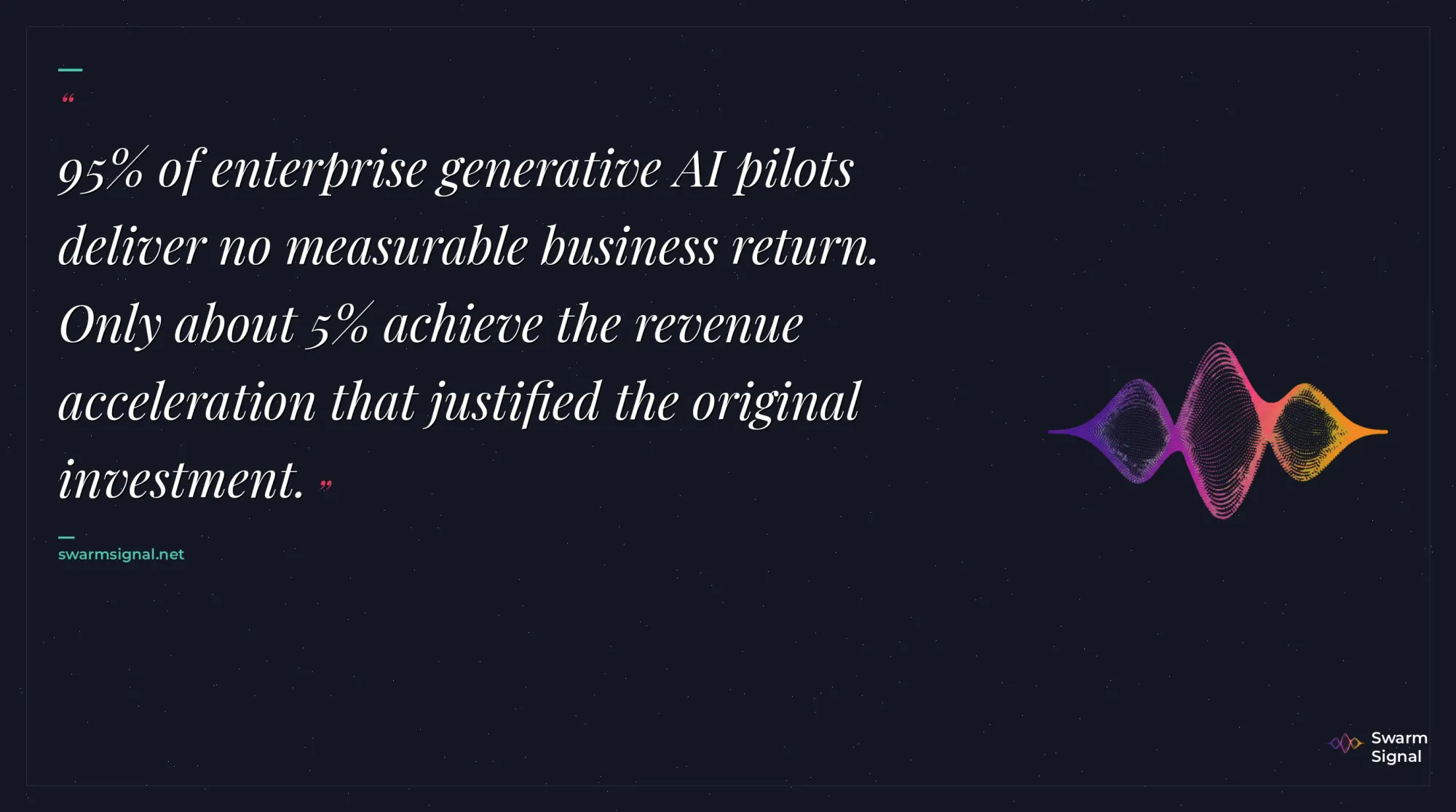
MIT's NANDA initiative published an even starker figure. Their GenAI Divide report, based on 150 executive interviews, 350 employee surveys, and 300 public deployments, found that 95% of enterprise generative AI pilots deliver no measurable business return. Only about 5% achieve the revenue acceleration that justified the original investment.
McKinsey's 2025 State of AI survey rounds out the picture. While 88% of organizations report using AI in at least one business function, only 6% qualify as "high performers" attributing more than 5% of EBIT to AI. Nearly two-thirds haven't begun scaling AI beyond isolated pilots. The gap between adoption and impact is enormous.
The Failure Is Organizational, Not Technical
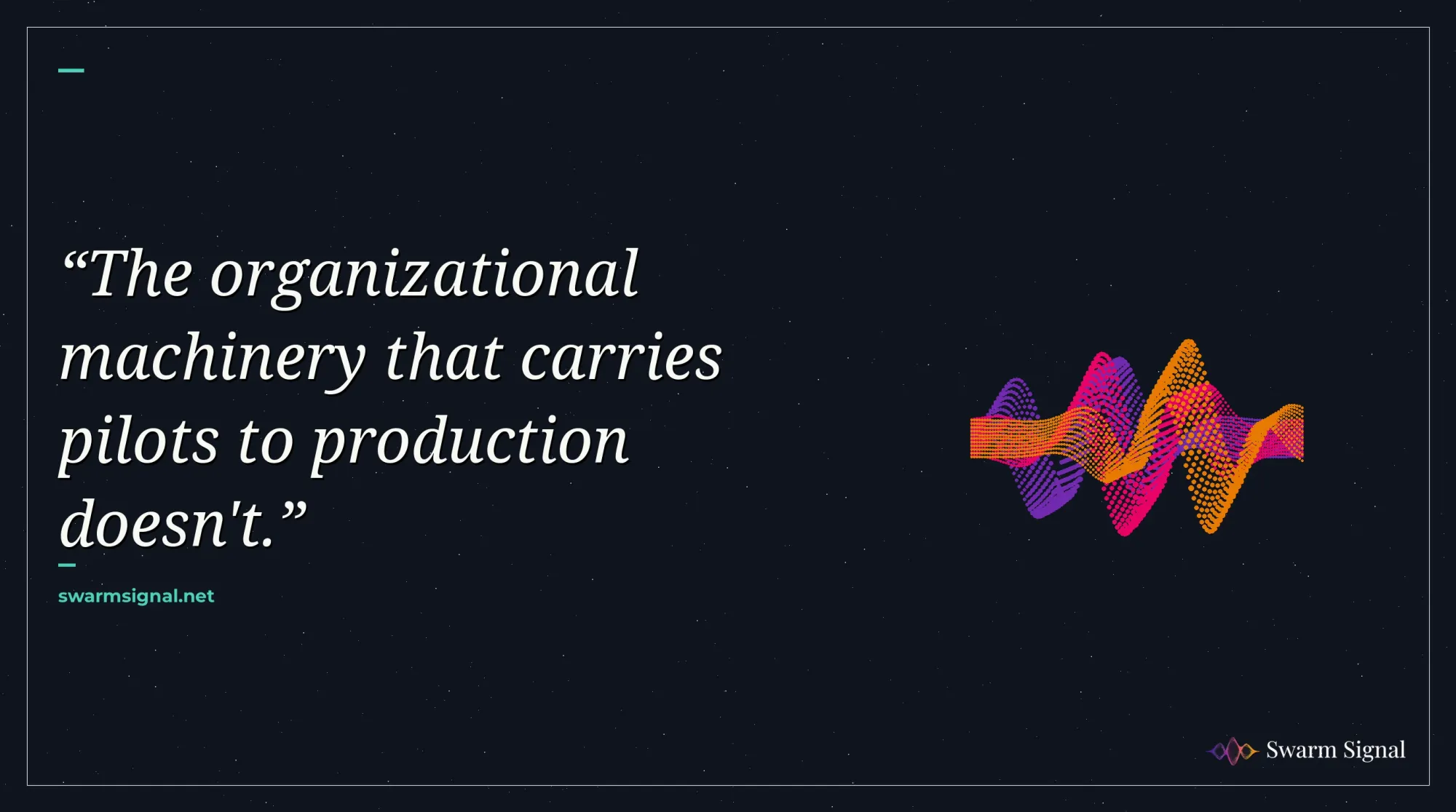
The consistent finding across all three studies is that technology isn't the bottleneck. The models work. The infrastructure exists. What breaks down is the organizational machinery that's supposed to carry a pilot into production.
HBR's analysis of enterprise AI failures identified a pattern they call "pilot paralysis." Teams launch proofs-of-concept in sandboxes but never design a path to production. One team builds the model. Another owns the data pipeline. A third manages the customer touchpoint. Nobody owns the business outcome.
Leadership disconnection accelerates the problem. McKinsey found that only 33% of senior leaders even somewhat understand how AI creates value for their business. When executives can't articulate what success looks like, projects drift. S&P Global's survey showed positive outcomes declining year-over-year across every enterprise objective: revenue growth dropped from 81% to 76%, cost management from 79% to 74%, and risk management from 74% to 70%.
Gartner predicts over 40% of agentic AI projects will be canceled by end of 2027 due to escalating costs, unclear business value, or inadequate risk controls. The pattern that killed predictive AI pilots is now repeating with agents at higher stakes and larger budgets.
What the 30% That Succeed Do Differently
Bain's 2025 Technology Report found a measurable gap between companies that follow deployment best practices and those that don't. Organizations adhering to four or more best practices realize 12% cost efficiency gains versus 5% for those following none. Winners also deploy more use cases on average (4.5 versus 3.3) and extract nearly twice the value per use case.
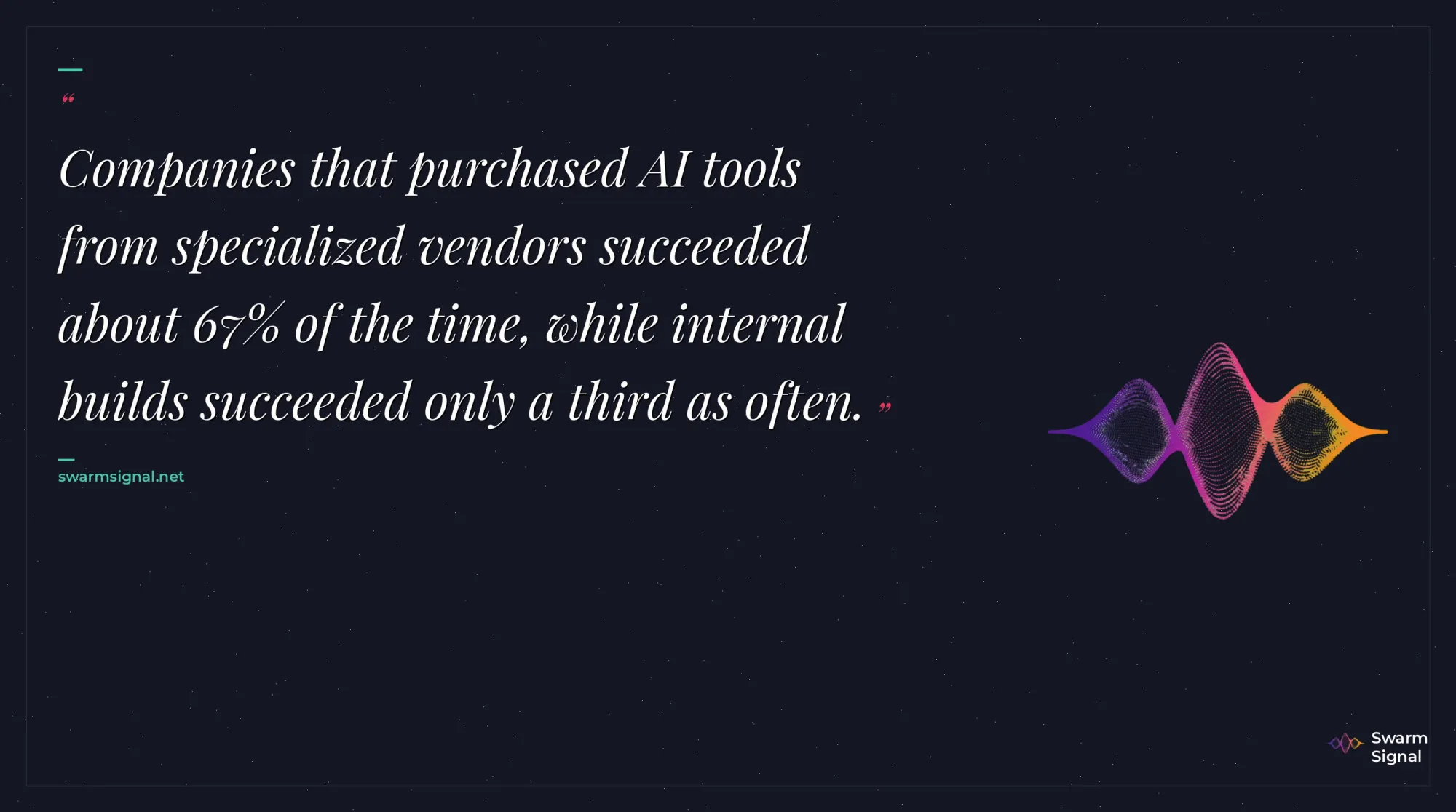
The MIT NANDA study identified another split. Companies that purchased AI tools from specialized vendors and built partnerships succeeded about 67% of the time, while internal builds succeeded only a third as often. More than half of generative AI budgets went to sales and marketing tools, but the biggest measured ROI came from back-office automation: eliminating business process outsourcing, cutting agency costs, and streamlining operations. Companies chasing flashy use cases failed. Companies targeting boring workflows succeeded.
Bain's research also shows software development leading in pilot-to-production conversion, with 40% of pilots reaching scale. Customer service, sales, and knowledge worker efficiency follow, with conversion rates between 20% and 33%. The common thread is that successful domains have clear metrics, measurable baselines, and existing workflows that agents can slot into without redesigning the organization.
The Pattern
The data points toward a specific conclusion. Enterprise AI doesn't fail because the technology is immature. It fails because organizations treat pilots as experiments rather than deployment rehearsals. They invest in models without investing in the governance, accountability, and change management required to move agents to production. They underestimate the true cost of production deployment and lose executive sponsorship when the bill comes due.
The 30% that make it through share a handful of traits: clear ownership of business outcomes, leadership that understands the value proposition, boring but measurable use cases, and a willingness to buy specialized tools rather than building from scratch. None of those traits require better AI. They require better organizations.
That's the uncomfortable truth behind the trillion-dollar agent panic. The technology is ready. The companies, mostly, are not.
Sources
Research:
- Voice of the Enterprise: AI & Machine Learning, Use Cases 2025 — S&P Global Market Intelligence (2025)
- The GenAI Divide: State of AI in Business 2025 — MIT NANDA / Fortune (August 2025)
- The State of AI in 2025 — McKinsey & Company (2025)
- How to Accelerate Progress on AI — Bain & Company (2025)
- Most AI Initiatives Fail: A 5-Part Framework — Harvard Business Review (November 2025)
- Gartner: 40% of Agentic AI Projects Will Be Canceled by 2027 — Gartner (June 2025)
Related Swarm Signal Coverage:
- Deploying AI Agents to Production
- The True Cost of AI Agents in Production
- The Trillion-Dollar Agent Panic