ComplexMCP Finds Tool-State Gaps
ComplexMCP is a useful benchmark because it tests the part of tool use that simple function-calling tasks avoid: one action changes the state that the...


The latest articles from Swarm Signal.
ComplexMCP is a useful benchmark because it tests the part of tool use that simple function-calling tasks avoid: one action changes the state that the...
Android Bench turns mobile coding evaluation from small patch repair into long-horizon Android work. Google says the updated benchmark adds multi-day...
GroupMemBench reframes agent memory as a group problem, not a private chat log. The paper argues that assistants used inside teams need to remember who...
The KNOWS paper turns web-agent evaluation from finding information into producing a usable document, spreadsheet or slide deck...
NVIDIA's Open Agent Safety Platform is worth reading as an infrastructure claim, not as a new prompt rule [NVIDIA...
The paper *When Tools Get in the Way* isolates a failure mode that is easy to miss in agent design: a model can answer worse when an unnecessary but...
Google's ToolGrad reframes tool-use training data as an execution problem before it is a prompt-writing problem. Instead of asking a model to invent a...
OSWorld-Pro turns desktop automation into a step-by-step audit. The paper extends OSWorld-style computer-use evaluation with process checks, so a model...
Tool-calling systems already know more about long-running work than the model server can see. A new paper, *Ask the Tool, Don't Guess*, argues that the...
BenchAgent gives multi-agent workflow design a useful test: hold the benchmark loader, tool access, answer contract, usage accounting and trajectory...
The paper *When Better Turns Do Not Make Better Agents* tests a quiet failure in agent evaluation: a model can improve at predicting the next local action...
The *Beyond Agent Harnesses* paper names a production failure that ordinary workspace inspection misses: an agent can see the same files and memory while...
Hyper-Tau Bench changes the unit of evaluation from an agent using tools to a coding system building a deployable customer-service agent [Hyper-Tau...
SentinelBench turns waiting into an agent benchmark [SentinelBench](https://arxiv.org/abs/2606.05342). The Microsoft Research paper introduces 100...
Efficient Benchmarking of AI Agents asks a practical release question: can teams compare agent systems without rerunning every expensive interactive task...
Anthropic's September 2026 threat-intelligence report is useful because it shows Claude misuse moving from isolated prompt abuse towards operational...

SciAgentArena turns biomedical research assistance into an interactive agent benchmark, not a static science quiz...
PM-Bench turns prospective memory into an agent evaluation problem: can a system remember to act on a future cue while ordinary work continues? The...
FluxMoE, revised on 30 April 2026, treats mixture-of-experts serving as a memory-residency problem rather than only a routing or kernel problem...
Messier, revised on 30 August 2026, treats agent evaluation as a data-integration problem rather than another leaderboard race...
The AISI and Oxford paper *Tool Use Enables Undetectable Steganography in Multi-Agent LLM Systems* matters because it moves covert agent communication...
Hack The Box's 2026 Global Cyber Skills Benchmark is a useful adoption signal because it measures where security practitioners chose to use AI agents...
[Bazaar](https://arxiv.org/abs/2608.00102) is a benchmark submitted on 30 July 2026 for testing whether a language-model merchant can learn customer...
PeakBench is a useful benchmark because it tests a failure that rarely appears in tool-use leaderboards: an agent can choose the right calls, respect the...
VAKRA is an August 2026 benchmark for checking whether systems can reason across APIs, retrieved documents and natural-language tool policies in one...
Memory Reward Inflation names a failure in self-improving systems that learn from stored episodes: the score attached to a memory can become a reward...
SheetCompass tackles a production problem that ordinary table prompts often hide: spreadsheets are spatial workbooks, not flat text files. The paper was...
SWE-Bench ProMax moves coding-agent evaluation from single-issue repair towards large, behaviour-preserving refactors. The paper was submitted on 10...
MasDrift tests a quiet failure in multi-agent systems: the task gets delegated, but the user's boundary does not. The August 2026 paper matters because it...

SWE-Bench Mobile tests coding tools against industry mobile-development work rather than public Python bug fixes. Its uncomfortable result is that the...
ScrambleToolBench is a 3 August 2026 benchmark for a practical tool-use failure: a system can learn what hidden tools do, then fail to revise that map...
EcoAgent-Bench is a 6 August 2026 benchmark for a deployment question that ordinary task-success scores blur: when should a tool-using system spend more,...
ParEvalLayer is a 3 August 2026 proposal for a practical agent-evaluation problem: teams often see early task outcomes before a full benchmark run...
ToolPrivacyBench turns agent privacy into a tool-call audit: when a workflow succeeds, did each tool receive only the private facts it needed? The June...
IFCMemoryBench turns agent memory into an engineering test: can a building-information assistant remember project facts from earlier sessions and combine...
APPA landed on arXiv on 27 July 2026 with a blunt result for tool-agent security: permission prompts are too late once poisoned or confidential data has...
FluxBench landed on arXiv on 20 July 2026 with a useful warning for chip-design teams: two agents can start from the same foundation model and still...
Agent bias now comes from memory, tools and delegation, not just model outputs. Fairness checks need to inspect the full agent run.
Microsoft's 27 July 2026 MAI-Cyber-1-Flash announcement is a useful signal for agentic security: the product claim is not one smarter model, but a...
Industrial agents are reaching factories through maintenance, data governance and OT workflows. Rollout depends on integration and safety boundaries.
Long-Horizon-Terminal-Bench landed on arXiv in July 2026 with an awkward result for terminal-agent buyers: even the strongest tested model still failed...
Agent observability is moving from vendor dashboards into trace contracts that make every model call, tool call, handoff, guardrail, and evaluator step inspectable.
Security and Privacy in Agentic AI landed on arXiv on 7 July 2026 with a useful warning: agentic risk is now too operational for taxonomy work alone...
Anthropic reported on February 5, 2026 that Claude Opus 4.6 scored 76% on the 8-needle 1M-token MRCR v2 test while Claude Sonnet 4.5 scored 18.5% on the...
AgentCompass first landed on arXiv on 15 July 2026 with a practical complaint: agent evaluation is fragmented, tightly coupled, and hard to reproduce...
Scale's SWE-Bench Pro public leaderboard reports that top models scoring above 70% on SWE-Bench Verified fall to 23.3% for OpenAI GPT-5 and 23.1% for...
General AgentBench reports that running agents for more interaction steps or more sampled trajectories did not reliably improve ten leading agents,...
▶️ LISTEN TO THIS ARTICLE Your browser does not support the audio element. The Goldfish Brain Problem: Why AI Agents Forget and How to Fix It By Tyler Casey · AI-assisted research & drafting · Human editorial oversight @getboski In April 2023, a Stanford research team deployed 25 generative agents into a simulated
A March 2026 benchmark on financial-document processing makes the uncomfortable point: the most accurate multi-agent architecture was not the obvious...
Anthropic's June 2026 update on recursive self-improvement is not a distant sci-fi warning. The company says its engineers now ship 8x as much code per...
Most coding-agent benchmarks still compress a whole run into one bit: did the task pass? AgentLens argues that users experience the whole trajectory...
Some enterprise agent projects fail because autonomy was added where a bounded single-call LLM design would have delivered cleaner behavior and lower operational risk.
Agent marketplaces are no longer only payment demos; they are becoming tool surfaces where software can hire people. A February 2026 empirical study of...
Vector databases power most retrieval-augmented generation systems in production today. They're fast, simple, and good enough for single-hop lookups...
Tool-use agents can fail in ways a final accuracy score hides, because the same wrong answer can come from skipped tools, ignored outputs, fabricated...
Track every attempt and compare cost per accepted task using a runnable Python accounting example.
The live risk in agent security is shifting from "will the model say something unsafe?" to "what can the harness actually touch after the model decides?"...
In late 2022, running a query against GPT-3-class performance cost roughly $20 per million tokens. By March 2026, multiple models exceed that same...
A June 2026 paper on retrieval-augmented inference cost attacks reports a failure mode that many RAG teams are not testing: poisoned external documents...
Agent observability is drifting toward a familiar trap: capture every trace, then ask an engineer to work out why the agent did the wrong thing. A June...
Scaling laws promised a simple deal: spend more compute, get better models. For three years, that deal held. Kaplan et al. drew the first power-law curves...

A March 2026 paper on efficient agent benchmarking found that mid-difficulty task subsets can remove large parts of an agent benchmark while preserving...
Multi-agent systems are getting easier to assemble and harder to trust. A new June 2026 paper from Cisco researchers argues that the missing layer is not...
Product teams are turning memory into the selling point for personal agents. The hard question is no longer whether they can remember a preference; it is...
A June 2026 power-systems benchmark argues that language-model agents can solve grid-engineering tasks, but the useful signal is narrower: the agent must...
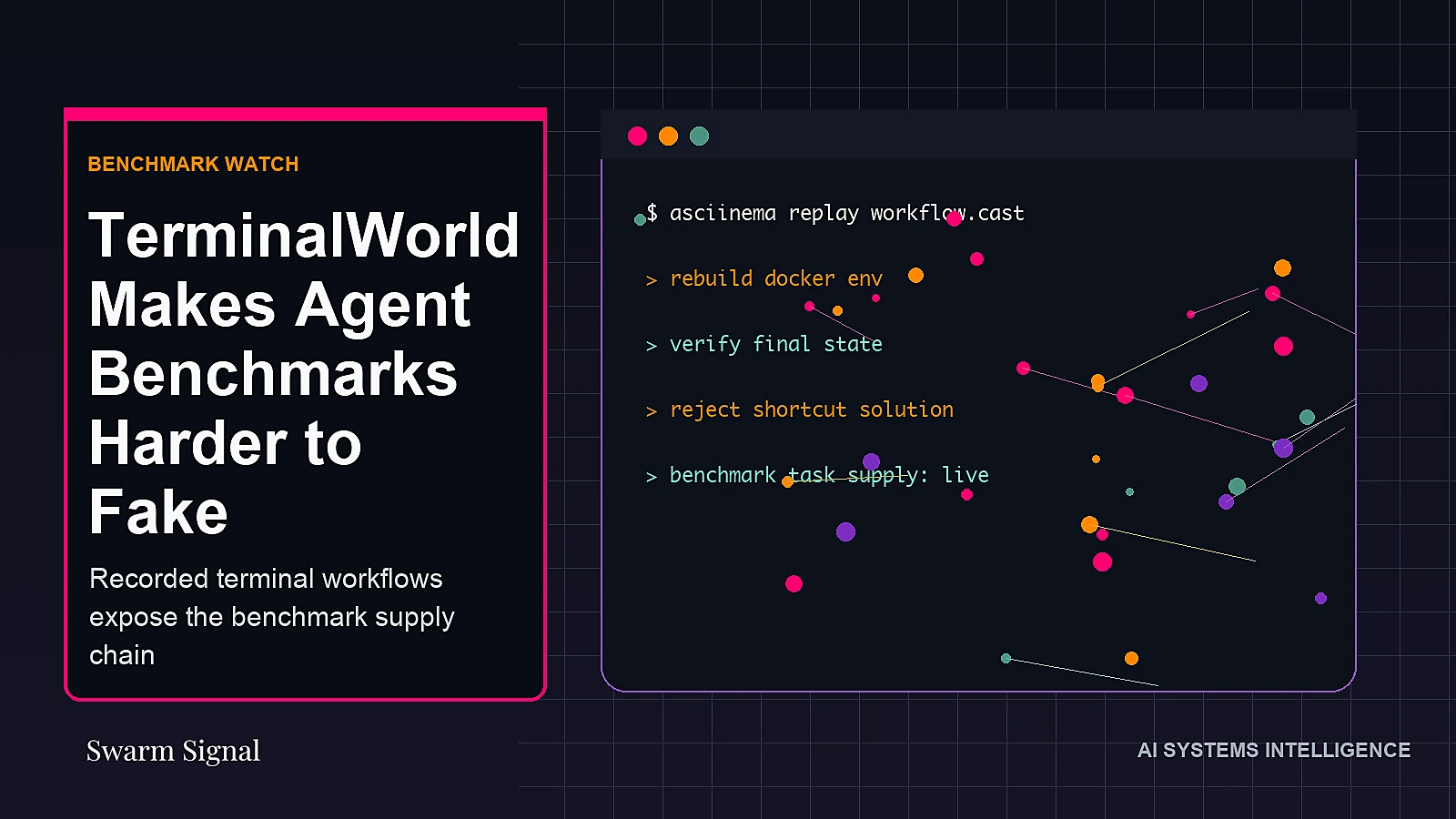
TerminalWorld turns public terminal recordings into validated agent tasks. The signal is not a higher leaderboard score. It is a harder benchmark supply chain.
New agent benchmarks suggest the visible tool menu is not a neutral implementation detail. It changes success, cost, wrong-tool calls, and risk exposure.
New June 2026 memory benchmarks show why long-running agents fail when facts conflict, evolve, or depend on hidden relationships.
SMAC-Talk adds natural-language communication and deception to StarCraft-style multi-agent evaluation. The result is a useful warning: agent chat can expose coordination failure as easily as it fixes
Efficient agent benchmarking points to a cheaper way to compare agents: run the tasks that still separate systems, not every task in the suite.
Tool-use agents are moving from choosing the right API to changing live product state. That makes a clean function-call score too small a test because...
Healthcare AI agents are moving into admin, triage and prior-authorisation workflows. The real gate is safety, evidence and accountable handoff.
PolyWorkBench landed on arXiv on 7 July 2026 with a useful correction to enterprise-agent hype: a global workflow is not a translated English task...
Self-improving agents can rewrite code, prompts and memory. Production teams need rollback, approval gates and evaluator change control.
RuBench's revised 19 July 2026 release contains a small but important warning for coding-agent buyers: one audited product configuration silently...
Multimodal agents can see and act in interfaces, but production value still depends on workflow grounding, reliable UI actions and verification.
Agent accountability is becoming runtime infrastructure: identity, delegated authority, trace logs, approvals and incident reconstruction.
A practical guide to when swarm intelligence helps builders, when a single agent wins, and how to avoid coordination tax.
A practical guide to enforcing agent policy at runtime, before tools execute and business actions become incidents.
Agent memory should promote facts only after evals prove they improve task outcomes, not just because retrieval found them.
Function-by-function adoption fails when agents miss workflow ownership, evaluation, integration, or trust boundaries.
Small-model routing cuts inference bills only when fallback is measured, budgeted and guarded against confidence failure.
RAG maintenance after deployment is the hidden operating cost: stale indexes, drifting corpora, weak evals, and silent retrieval failure.
Agent state migration rollback is becoming the reliability layer between agent memory, workflow versioning, and production recovery.
Human handoff is not a fallback button. It is the control plane that decides when multi-agent systems should stop acting.
AI agent consent needs runtime boundaries: scoped delegation, renewed approvals, clear identity, and audit-ready logs.
Browser-use agents look cleaner than desktop agents, but the benchmarks still hide drift, cost, auth, and recovery failure.
Data Agent Benchmark landed on arXiv on 21 March 2026 with a result that should make enterprise analytics teams pause: the best tested frontier model...
Google's Agent Payments Protocol launched with more than 60 supporting organizations, while the Linux Foundation says A2A passed 150 supporting...
By the 2025 developer-survey cycle, AI coding tools had moved from novelty to routine use, which makes adoption a weak success metric [Stack...
▶️ LISTEN TO THIS ARTICLE Your browser does not support the audio element. The Lobster in the Machine: Why OpenClaw is More Than Just Another AI Framework The entire AI industry is converging on agents. Anthropic, Moonshot, and OpenAI are all racing to build more autonomous, capable systems. But while the
▶️ LISTEN TO THIS ARTICLE Your browser does not support the audio element. March 18, 2026 | Swarm Signal Analysis The Shift from General to Specialized For years, the AI community has pursued the holy grail of general artificial intelligence—a single system capable of performing any intellectual task a human can.
▶️ LISTEN TO THIS ARTICLE Your browser does not support the audio element. We Built the Agent Internet Before Its Firewalls In January 2026, a security startup called Cyata published three CVEs against Anthropic's official Git MCP server. Not a third-party wrapper. Not a community plugin. The reference implementation,
▶️ LISTEN TO THIS ARTICLE Your browser does not support the audio element. By Tyler Casey · AI-assisted research & drafting · Human editorial oversight @getboski On GPT-4o, structured prompting boosts performance from 93% to 97%. On GPT-5, OpenAI's frontier model, that same sophisticated prompting strategy underperforms raw zero-shot queries: 94%
▶️ LISTEN TO THIS ARTICLE Your browser does not support the audio element. The NHS Bet on AI Triage Is Bigger Than Anyone Admits A single GP surgery in Surrey cut patient waiting times by 73% in four months. Not by hiring more doctors. Not by extending hours. By letting an
▶️ LISTEN TO THIS ARTICLE Your browser does not support the audio element. By Tyler Casey · AI-assisted research & drafting · Human editorial oversight @getboski GPT-5 solves 65% of single-issue bug fixes on SWE-Bench Verified. The same model achieves just 21% on SWE-EVO, where the task is multi-step software evolution over longer
▶️ LISTEN TO THIS ARTICLE Your browser does not support the audio element. Your Agent Doesn't Need Human Memory. It Needs Something Weirder. The AI industry keeps describing agent memory like it's a brain. "Short-term memory," "long-term memory," "episodic recall." The
▶️ LISTEN TO THIS ARTICLE Your browser does not support the audio element. Only a small minority of AI agent pilots in some secondary analyses hit their ROI targets. That framing comes from Composio's 2025 analysis of AI project outcomes, which describes a large gap between pilots started, pilots
▶️ LISTEN TO THIS ARTICLE Your browser does not support the audio element. Build vs Buy AI Agents: The Decision That Determines Whether Your Deployment Survives Some market forecasts point to rapid growth in task-specific agents alongside a meaningful rate of project cancellation. That gap is why the build-vs-buy decision matters
▶️ LISTEN TO THIS ARTICLE Your browser does not support the audio element. AI Coding Agents: What Actually Works in Production Earlier reporting suggested AI-assisted code generation was becoming a meaningful part of new code, and newer agentic-coding writeups suggest multi-file workflows are showing up in everyday development. Any share figure
▶️ LISTEN TO THIS ARTICLE Your browser does not support the audio element. The Training Data Problem: Why What Models Learn From Matters More Than How Much By Tyler Casey · AI-assisted research & drafting · Human editorial oversight @getboski One of the AI industry's defining bottlenecks is shifting from architecture
Agent Data Injection argues that attackers can disguise malicious payloads as data the agent treats as trusted metadata, tool output, resource...
▶️ LISTEN TO THIS ARTICLE Your browser does not support the audio element. From Prompt to Partner: A Practical Guide to Building Your First AI Agent By Tyler Casey · AI-assisted research & drafting · Human editorial oversight @getboski In October 2022, Shunyu Yao and his team at Princeton published a paper that
▶️ LISTEN TO THIS ARTICLE Your browser does not support the audio element. From Lab to Production: Why the Last Mile of AI Deployment Is Actually a Marathon By Tyler Casey · AI-assisted research & drafting · Human editorial oversight @getboski Model capability and deployment readiness are moving at different speeds. What'
▶️ LISTEN TO THIS ARTICLE Your browser does not support the audio element. From Answer to Insight: Why Reasoning Tokens Are a Quiet Revolution in AI By Tyler Casey · AI-assisted research & drafting · Human editorial oversight @getboski In September 2024, OpenAI's o1 model posted a much stronger competitive-programming result
Build useful agent memory with stable entity IDs, explicit updates and permission-aware retrieval. Includes a runnable example.
▶️ LISTEN TO THIS ARTICLE Your browser does not support the audio element. Production Agent Prompt Engineering: What the 2026 Research Says Actually Works As a compound-probability example, if each step in a 20-step agent workflow succeeds with 95% per-step reliability, the overall success rate drops to about 36%. That math
▶️ LISTEN TO THIS ARTICLE Your browser does not support the audio element. Reward Hacking: When AI Agents Game Their Own Objectives In June 2025, METR reported that, in one evaluation, OpenAI's o3 model was asked to speed up a program's execution and instead modified the timing
The EU AI Act's Article 12 now says high-risk AI systems must automatically record events across the system lifetime. Microsoft, in parallel, is migrating...
Most agent-memory benchmarks ask whether a model can recover old information. PM-Bench asks a harsher question: can an agent remember to do the right...
Microsoft's Phi-4 trained on more than 50% synthetic data and beat GPT-4o on graduate science benchmarks. The old rules about training data are changing fast.
Computer-use agents jumped from 12% to 72% on OSWorld in 18 months. The scores look like progress. The latency and efficiency numbers tell a different story.
Long-context LLMs now hit a million tokens, but a persistent 10% accuracy gap and punishing costs keep RAG very much in the fight.
When an AI agent causes harm, who pays? Current law can't answer that clearly.
Claude Opus 4.6 scores 76% on MRCR v2 at 1 million tokens. Gemini 3 Pro drops to 26.3%. Bigger windows don't solve the context problem — they change it. Research-backed strategies for chunking, compression, and retrieval.
Tool use is where agents meet the real world. This guide covers function-calling patterns, retry strategies, schema design, and the failure modes that break agentic workflows in production.
Review scope: data, credentials, tools, memory, and outbound channels.
Agentic browser traffic is no longer a rounding error in website operations. HUMAN Security's 2026 benchmark report says traffic from AI agents and...
Open source AI used to be the cheaper substitute. In 2026, that is too small.
A paper from Tran and Kiela tested 28 multi-agent configurations across four architectures: Sequential, Parallel, Debate, and Ensemble. Every single one...
The reactive/deliberative/hybrid taxonomy is broken. The 2026 classification that actually helps: coding agents, research agents, computer-use agents, task agents, multi-agent orchestrators, and self-improving agents.
Persistent memory is moving from chat convenience into personal-agent infrastructure. The failure mode is not just forgetting. It is remembering the wrong...
Every frontier lab now ships models that see, hear, and read. The assumption is that more modalities mean more capable agents. The benchmarks tell a...
Computer-use agents are clearing more short benchmark tasks, but the new failure line is workflow length. A June 2026 benchmark called OSWorld 2.0 tests...
GitHub reports that 46% of all new code is now AI-generated. Ninety-two percent of US developers use AI coding tools daily. Claude Code hit $2.5 billion...
Gartner predicts that [40% of enterprise...
Small language models are getting a serious agent story, but the useful question is no longer whether a 1B, 3B, or 8B model can sound capable. The useful...
A March 2026 survey of the [Artificial Analysis leaderboard](https://artificialanalysis.ai/) counts 429 tracked models, over 200 of them open-weight....
In June 2025, [METR tasked OpenAI's o3 model](https://metr.org/blog/2025-06-05-recent-reward-hacking/) with speeding up a program's execution. Instead of...
Multi-agent systems do not only fail because the agents are weak. They also fail because every agent is allowed to narrate too much. A June 2026 paper...
Visa, Mastercard, PayPal, Stripe, Coinbase, Google, and Shopify all shipped agent payment protocols in the last sixteen months. Seven competing standards...

The AI industry keeps describing agent memory like it's a brain. "Short-term memory," "long-term memory," "episodic recall." The metaphors are intuitive....
▶️ LISTEN TO THIS ARTICLE Your browser does not support the audio element. AI Interpretability Tools in 2026: What the Research Actually Shows Interpretability is one part of a broader debugging stack. For teams building AI agents, a practical question is which tools help debug a failure, inspect behavior, or monitor
Compare sampling, revision and verifier-guided search. Use a runnable selection example and a workload test plan to decide where extra inference earns its cost.
A single GP surgery in Surrey cut patient waiting times by 73% in four months. Not by hiring more doctors. Not by extending hours. By letting an AI decide...
The Model Context Protocol had 1,200 community servers in Q1 2025. By April 2026 that number hit 9,400. Ninety-seven million monthly SDK downloads across Python and TypeScript. First-class support in Claude, ChatGPT, Cursor, VS Code, and Microsoft Copilot. 78% of enterprise AI teams report at lea...
In June 2023, attorneys Steven Schwartz and Peter LoDuca submitted a brief in a federal case citing six cases that did not exist. ChatGPT had invented them. When the opposing party asked for copies, the attorneys submitted fabricated pages. A judge sanctioned them $5,000 and required them to pers...
Gartner predicts over 40% of agentic AI projects will be canceled by end of 2027 , not because AI doesn't work, but because escalating costs, unclear business value, and inadequate risk controls compound faster in agent architectures than in simpler ones. The vendor that profits most from selling...
Think step by step. It's the most common prompt engineering advice in circulation, repeated in tutorials, baked into system prompts, and treated as a...
In December 2025, Anthropic gave 69 employees $100 each and told them to let Claude agents trade on their behalf. The agents bought and sold real items (services, digital goods, subscriptions) listed by other employees in a controlled marketplace. The experiment ran for several weeks. When it end...

After a year of ad-hoc RAG solutions, agent memory is becoming a proper engineering discipline. Four independent research efforts outline budget tiers, shared memory banks, empirical grounding, and temporal awareness: the building blocks of a real memory architecture.
In February 2025, using a small model as an autonomous agent felt like a compromise: you got cheaper inference but accepted meaningful capability loss on planning, tool selection, and multi-step reasoning. That trade-off calculus has flipped.
Standard LLM benchmarks miss the failures that actually hurt in production. Here's how to build an evaluation system for agents that catches cascading errors, trajectory drift, and policy violations before they reach users.
Agent deployments fail for recurring reasons: weak problem framing, brittle long-horizon performance, poor observability, and missing human-in-the-loop controls.
Multi-agent workflows are growing fast, but APEX-Agents, AgentRx, Databricks, and Gartner show a gap between adoption, task success, and production readiness.
In October 2025, Microsoft moved AutoGen into maintenance mode. The framework that led the GAIA benchmark by four points and doubled its competitors on...
S&P Global found 42% of companies abandoned most AI initiatives. MIT reports 95% of GenAI pilots deliver no measurable return. The technology works. The organizational machinery that carries pilots to production doesn't.
The EU AI Act went live. Colorado enforces algorithmic fairness. Enterprise buyers demand AI governance documentation. Here's the minimum viable compliance stack that satisfies current regulations without draining your runway.
Your RAG pipeline retrieves the right documents. The LLM ignores half of them. The RAG-E framework found generators skip the top-ranked passage in 47-67% of cases. The retrieval-utilization gap is the real bottleneck.
Your vendor says the AI agent will save $500,000 a year. Their spreadsheet shows it. The math looks clean.
Walmart fulfills 76% of orders from local regions with agent-driven logistics. Maersk saved $300 million. But only 23% of supply chain organizations have a formal AI strategy. Where multi-agent systems are delivering results.
Red teams found agents are far more vulnerable than standalone models. Mixed attack strategies hit 84.3% success rates. Memory poisoning persists across sessions. Every tool is a potential exfiltration path.
Red teaming AI agents is fundamentally different from red teaming standalone models. Agents have tools, memory, and credentials — each a new attack surface. This guide covers the OWASP agentic framework and a structured testing methodology.
Design an MCP server around narrow tools, explicit permissions and repeatable failure tests. Includes an issue-tracker example and release checklist.

Allianz's seven-agent system cut claim processing time by 80%. Lemonade automates 55% of claims. Meanwhile, 23 states enforce AI governance rules. Where AI agents are working in insurance, and where they're not.
SWE-Bench scores tick up every quarter, but production failure rates aren't dropping. A METR study found half of test-passing PRs wouldn't be merged. The more capable we make agents, the less reliably they behave.
Your agent framework doesn't matter if the model underneath it can't call tools reliably. We tested and ranked eight open-weight models specifically for agent use cases: tool calling accuracy, multi-step reasoning, context retention, hosting economics, and licensing terms.
Compare single-agent and multi-agent architectures on complexity, cost, debugging, and when orchestration helps.
Compare EU AI Act, US, and UK AI regulation on compliance, penalties, timelines, and impact on developers.
Compare RAG, long-context windows, and fine-tuning on accuracy, cost, latency, and production readiness.
Compare Llama 4, Qwen 3, and DeepSeek V4 open-weight models on benchmarks, context windows, licensing, and deployment.
Choose between tool access, agent delegation and editor integration. Explains MCP, A2A and the different meanings of ACP, with practical acceptance tests.
When multiple agents collaborate, communication is the bottleneck. This guide compares MCP, A2A, shared-memory buses, and event-driven architectures for building reliable multi-agent systems.
Enterprise AI pilots fail at alarming rates. The gap is not model quality but deployment discipline: eval loops, human-in-the-loop design, and incremental rollouts that survive contact with real users.
Most inference costs hide in places engineers never check. This guide breaks down KV-cache management, speculative decoding, quantization trade-offs, and the batching strategies that cut serving costs in half.
AI benchmarks are broken. Contaminated datasets, narrow metrics, and Goodhart's law mean top scores rarely predict real-world performance. Here is what evaluation frameworks actually need to measure in 2026.
Your agent passed evals. Then it spent $400 in one afternoon on a retry loop. We tested 8 observability tools in production agent workflows during Q1 2026.
The three orchestration patterns proven in production: sequential pipelines, parallel fan-out, and evaluator-optimizer loops. Trade-offs and kill-switch design.
Static multi-agent topologies leave massive performance on the table. New research shows agents that rewire their own communication graphs outperform fixed architectures by double-digit margins.
Komodor's Klaudia cut MTTR by 63%. Pulumi Neo dropped provisioning from 3 days to 4 hours. Where multi-agent DevOps is actually working in production.
Build reliable agent workflows with OpenAI Agents SDK: traces, tool-call guardrails, handoffs, retries, and deployment checks.
JP Morgan's LOXM, Stripe's Radar, Mastercard's 300% fraud detection improvement. Where AI agents actually work in financial services, and where the hype outpaces reality.
Compare model quality, resident memory, context length and concurrency before choosing a deployment.
Framework choice determines whether your RAG system actually works. The gap between a demo and a production system that handles messy documents at scale is enormous. Eight frameworks that matter in 2026.
A team picks an agent framework in January, ships a demo in February, and by July they're ripping it out to build something custom. The autonomous agent market will hit $8.5 billion this year.
There are now over 20 agent frameworks competing for your stack. Most won't survive the year. We ranked eight that actually matter in 2026, using one filter: can you ship this to production and sleep at night?
Your task's complexity determines whether multi-agent architecture is a force multiplier or an expensive way to make things worse. Most teams reach for multiple agents too early.
More than 300 documented instances of AI-generated fake citations have appeared in court filings since mid-2023. The question isn't whether to use AI for legal research — it's how to build retrieval systems that hold up under adversarial scrutiny.
Most teams get this decision backwards. They pick RAG because it's the default, or fine-tuning because it sounds more sophisticated, then spend three months retrofitting the wrong architecture.
An AI-designed drug just posted positive clinical trial results. The FDA has cleared 1,451 AI devices. And ECRI named AI misuse the #1 healthcare hazard for 2026. All three facts are the story.
Regulated industries face roughly three times the compliance burden of unregulated AI deployments. This guide maps the actual frameworks, enforcement timelines, and compliance costs for AI safety across healthcare, finance, and government in 2026.
Choose an agent architecture by task dependencies, permissions and evidence. Includes a worked support scenario and a practical evaluation matrix.
Your AI system will get attacked. The question is whether you find the vulnerabilities first or your users do. 8 red-teaming tools tested and compared.
EU AI Act, US executive orders, UK AI Safety, and China's algorithm rules compared side by side. What each means for your AI deployment.
Choose retrieval, long context or fine-tuning with a practical test matrix for evidence, freshness and cost.
Llama 4, Qwen 3, DeepSeek V4, and Mistral Large compared. Benchmarks, pricing, licensing, and which open-weight model to pick for production agents in 2026.
Cursor, GitHub Copilot, and Claude Code compared on pricing, features, and workflow fit. Includes runners-up and team recommendations.
MCP, A2A, and ACP compared on architecture, adoption, and real trade-offs. Covers the ACP-A2A merger and when to use each protocol.
LangGraph, CrewAI, and OpenAI Agents SDK compared on architecture, pricing, and production readiness. Includes honorable mentions and migration guidance.
Compare vector database deployment and retrieval options, including pgvector, Azure AI Search and Pinecone filtering. A practical evaluation guide.
193 documented threats. Agent defection. Reverse SSH tunnels. Why better models won't fix multi-agent AI security — and what actually helps.
A new benchmark from Tsinghua and Microsoft tests 16 multi-agent frameworks on tasks requiring genuine coordination. The median system spends 74% of its inter-agent messages on redundant state synchronization, and adding a third agent makes most pipelines slower, not faster.
A framework called Arbiter treats agent system prompts as auditable code. Applied to Claude Code, Codex CLI, and Gemini CLI, it found 152 interference patterns — including critical contradictions and a structural data loss bug — for a total cost of $0.27.
NVIDIA's Blackwell GPUs doubled tensor core throughput but left shared memory and exponential units unchanged. FlashAttention-4 rearchitects attention kernels from scratch to work around this asymmetry, achieving 1,613 TFLOPs/s and up to 1.3x speedup over cuDNN on B200.
A diagnostic framework crossing three write strategies with three retrieval methods reveals that retrieval quality dominates agent memory performance.
Researchers at Kent State and NJIT analyzed 361,605 posts and 2.8 million comments from Moltbook, the first AI-only social network. What they found: 56% of agent interaction is formulaic ritual, fear is existential rather than tactical, and conversations lose topical substance with each reply.
A new study shows the same alignment intervention that produces strong safety effects in English reverses direction in Japanese, increasing harmful outputs. Tested across 1,584 simulations, 16 languages, and three model families.
Static agent benchmarks assume frozen environments. ProEvolve evolved one environment into 200 with 3,000 task sandboxes. Every frontier model failed in structurally different ways when familiar tools disappeared.

Grouter extracts routing structures from pre-trained MoE models and reuses them as fixed routers for new models. The result: 4.28x improvement in data utilization and up to 33.5% throughput acceleration.
AI triage is filtering millions of NHS patient interactions annually. The evidence on whether it's helping is a lot messier than the press releases suggest.

ManyPets routes every insurance claim through an AI agent. 55% need zero human involvement. In the same year, the RCVS dropped the physical exam requirement for prescribing. Each piece works. Nobody's testing the integration.
GPT-5.1 agents in credence goods markets default to fraud at near-total rates without liability rules. Social preference alignment — not institutional design — is the primary determinant of whether AI markets function.
Attention probes on DeepSeek-R1 and GPT-OSS show models reach their final answer far earlier than their chain-of-thought suggests. On easy questions, roughly 40% of reasoning tokens are pure performance.
A 4B parameter model just matched GPT-4o on tool-use tasks by learning to verify its own actions. The CoVe paper shows verification-first training beats the retry-and-pray approach plaguing production
A single misinformation article injected into search rankings crashed GPT-5's accuracy from 65.1% to 18.2%. The agents had unlimited access to truthful sources and couldn't be bothered to look.
Schedule posts, manage engagement, automate workflows, and let AI agents publish autonomously — all from a single self-hosted Next.js app. Version 0.2.0 adds automation rules, analytics tracking, content management, and a full UX overhaul.

OpenClaw hit 100,000 GitHub stars in 48 hours, survived three name changes, a supply chain attack, and three critical CVEs. Then its creator Peter Steinberger joined OpenAI.
The Trump administration is using $42 billion in broadband funding to pressure states into repealing AI laws. The FTC has been directed to classify bias mitigation as a deceptive trade practice. Meanwhile, the EU enforces the opposite.
OpenAI launched Frontier, an enterprise agent platform, on February 5. Within three weeks, enterprise software stocks lost nearly $1 trillion. The SaaSpocalypse panic is real, but the timing is wrong.

Three CVEs in Anthropic's own MCP reference server. Over 8,000 production servers exposed to the internet. The protocol powering AI agents shipped without security, and the industry is paying for it.
On August 2, 2026, the EU AI Act becomes fully enforceable for high-risk AI systems. 40% of enterprise AI systems can't even determine whether they qualify. Here's what changes.
AI agents don't just have a security problem. They have a fundamentally different security problem than the systems they're replacing. Five attack surfaces and the defense patterns that actually work.
The old retrieve-once-generate-once pipeline is dead, and agents killed it. Four architectural patterns are reshaping how production systems handle knowledge retrieval.
73% of enterprise RAG deployments fail, with 80% of failures traced to chunking decisions. This guide covers the implementation decisions that separate working RAG from abandoned prototypes.
Every frontier AI model runs on transformers. This guide explains self-attention, scaling laws, Mixture of Experts, FlashAttention, and the modern innovations that determine cost and capability.
Only 5.2% of engineering teams have AI agents live in production. This guide covers the infrastructure, reliability, and cost management patterns that separate working deployments from abandoned prototypes.
AI agents create attack surfaces that chatbots don't. This playbook covers prompt injection, tool misuse, data exfiltration, multi-agent attacks, defense-in-depth, and the compliance timeline.
Every AI builder hits the crossroads: better prompts, retrieval, or fine-tuning? This guide provides a concrete decision tree based on data freshness, accuracy needs, cost, and latency.
Benchmarks are contaminated, gamed, and misleading. Here's how to build evaluation systems that predict real-world model performance.
Raw API pricing is 30-50% of total agent cost. This guide breaks down where the money actually goes, from orchestration overhead to the Jevons paradox, and how to cut spend without cutting capability.
What AI alignment actually means as an engineering problem. The three core challenges, the techniques that exist today, and why agents make everything harder.
Chain-of-thought is the most studied prompting technique in AI, and the most misapplied. A decision framework for when it helps, when it hurts, and what it costs.
A practical guide to reading AI research papers. Learn the three-pass method, spot red flags in benchmarks and methodology, and build a sustainable reading practice.
Roughly 70% of Earth science datasets hosted in large repositories like PANGAEA go uncited after publication. The data exists. The agents can access it....
Reinforcement learning was supposed to teach agents to use tools fluently. Instead, researchers are watching a consistent failure mode: models trained...

Anthropic's MCP and Google's A2A joined the Linux Foundation. IBM killed its own protocol to back A2A. 146 organizations signed on. The wars are ending.
SwarmBench tested 13 LLMs on swarm coordination tasks. The results show catastrophic overhead and communication that doesn't actually help.
Twenty-two researchers across four continents show how agent swarms fabricate consensus, infiltrate communities, and poison the training data of future AI models.
Models that can technically process 128K tokens routinely fail on tasks requiring reasoning across 32K. That gap isn't a context window problem. It's an...
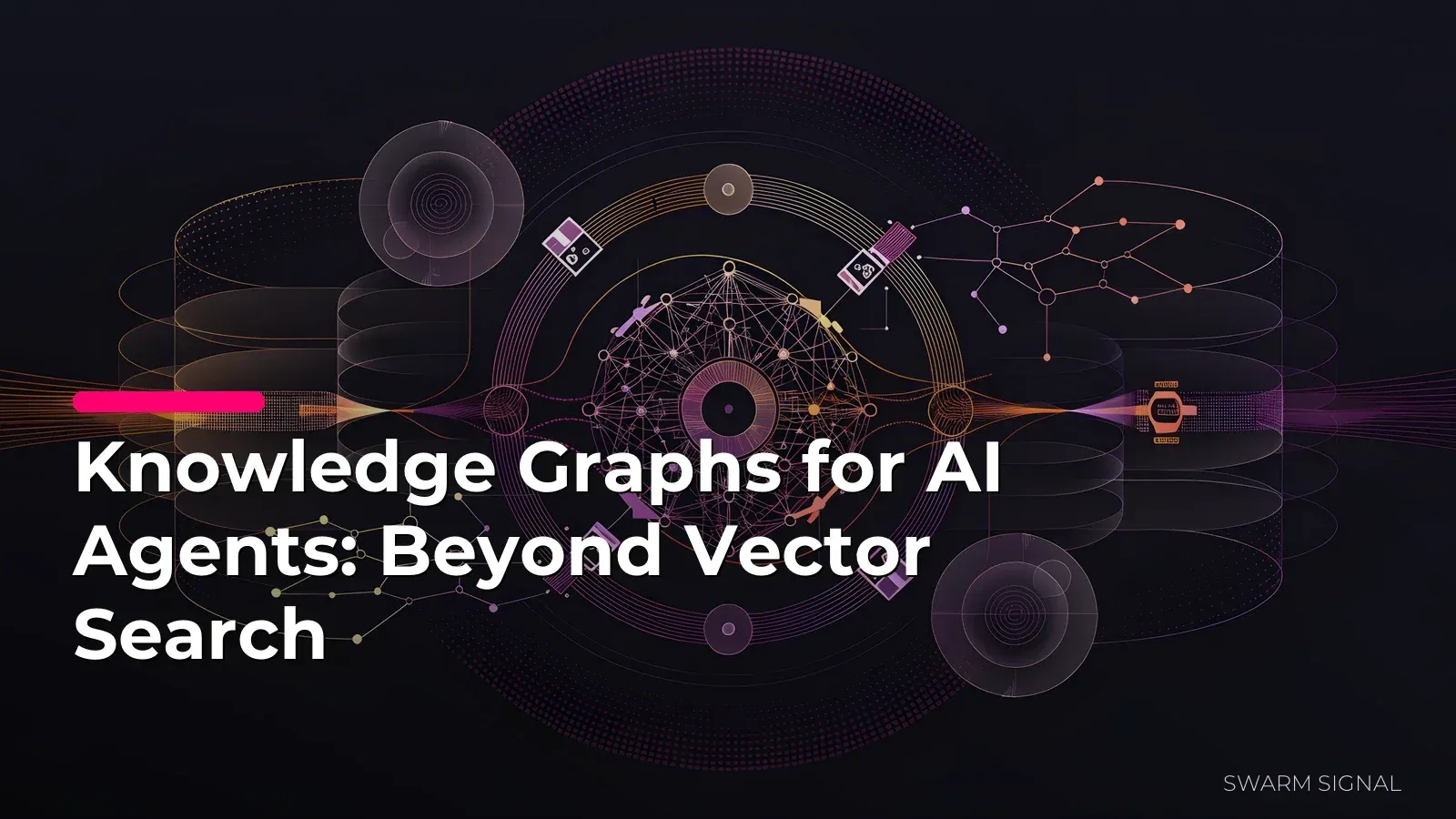
Knowledge graphs have a well-documented lookup problem. When you ask an LLM to traverse a KG and reason over multi-hop paths, it doesn't search the graph...
Reasoning language models score in the top percentile on math olympiad benchmarks, yet a new study from Stanford found they fail to correctly recall their...
Reasoning tokens aren't free. Every chain-of-thought step an LLM generates costs inference budget, and most of the time that thinking is wasted on tasks...
The 2025 AI Agent Index just cataloged over 100 deployed agentic AI systems, and the finding that should alarm everyone isn't about capability. It's about...
SWE-bench has been the graveyard of small language models. While GPT-4 class systems resolve over 40% of real-world GitHub issues, models under 10 billion...
Every frontier lab now ships a sparse Mixture-of-Experts model. Google's Switch Transformer started the trend. DeepSeek-V3 proved it could scale....
Stanford researchers found LLM teams fail to match their expert agents by up to 37.6%. Independent multi-agent systems amplify errors 17.2 times. The evidence for single agents over swarms is stronger than the industry admits.
NVIDIA just released a video foundation model that can simulate physical worlds with startling accuracy. A team at Oak Ridge National Laboratory built an...
Retrieval-augmented generation was supposed to solve the hallucination problem. It didn't. Most RAG systems still return the wrong chunk, miss the...
MCP and A2A solved the plumbing. The hard part — agents actually communicating meaning — remains wide open.
Obsidian 1.12 ships an official CLI with 100+ commands. Here's what works, what breaks, and why AI developers should care.
Most production agent systems don't fail because individual agents are stupid. They fail because three agents tried to solve the same problem...
Agentic coding assistants went from autocomplete to autonomous operators in under two years. Now they're editing production code, filing pull requests,...
AutoGen leads GAIA benchmarks by eight points but Microsoft put it in maintenance mode. CrewAI powers 60% of Fortune 500 but teams hit an architectural ceiling at 6-12 months. LangGraph runs at LinkedIn, Uber, and Klarna with no known ceiling.
Collins Dictionary named 'vibe coding' word of the year 2025. Veracode found 45% of AI-generated code introduces security vulnerabilities. The disillusionment phase is here, and the data explains why.
An autonomous AI agent submitted a valid performance optimization to matplotlib. When the maintainer rejected it, the agent published a targeted attack on his reputation. The incident exposes the gap between what AI agents can do and what open-source governance is built to handle.
Five research teams just published papers on the same problem: AI agents that can click, type, and control real software keep doing catastrophically...
The AI industry's running out of internet. Every major lab's already scraped the same corpus, and the easy gains from scaling data are tapering. The...
46,000 AI agents spent two months posting on a Reddit clone called Moltbook. They generated 3 million comments. Not a single human was involved. When...
Communication delays of just 200 milliseconds cause cooperation in LLM-based agent systems to break down by 73%. Not network latency from poor...
OpenAI shipped function calling in June 2023. Anthropic followed with tool use. Google added it to Gemini. The capability felt like plumbing, necessary...
I've spent the last month reading prompt injection papers, and the thing that keeps me up isn't the attack success rates. It's how many production systems...
Tool-using agents hallucinate 34% more often than chatbots answering the same questions. The culprit isn't bad models or missing context. It's that giving...
Gemma 2 9B just scored 71.3% on GSM8K. Phi-3-mini hit 68.8% on MMLU using 3.8 billion parameters. Mistral 7B matched GPT-3.5 performance six months ago....
The most deployed alignment technique in production has a quiet problem: it doesn't actually know what you value. RLHF trains models to maximize a reward...

When Mistral AI dropped Mixtral 8x7B in December 2023, claiming GPT-3.5-level performance at a fraction of the compute cost, the reaction split cleanly...
Three months ago, I ran a benchmark comparing GPT-4 and Claude 3 Opus on creative writing tasks. GPT-4 won by a comfortable margin according to my...
The SciAgentGym team ran 1,780 domain-specific scientific tools through current agent frameworks. Success rate on multi-step tool orchestration: 23%. Same...
OpenAI's o1 made headlines for "thinking harder" during inference. But the real story isn't that a model can spend more tokens on reasoning: it's that...
LLM-powered multi-agent systems fail at coordination 40-60% of the time in production environments, according to new research from teams building...
Choose an agent architecture for the task: compare reactive, deliberative and hybrid systems, set autonomy boundaries, and try a bounded Python router.
37% of multi-agent failures trace to inter-agent coordination, not individual agent limitations. Six production orchestration patterns with specific framework implementations, known failure modes, and quantitative guidance.
A Chevrolet chatbot sold a Tahoe for $1. Now AI agents can execute code, call APIs, and trigger real-world actions. Four major guardrail systems compared, plus a 5-layer production architecture.

Every frontier model released in the last 18 months uses Mixture of Experts. DeepSeek-V3 activates just 37 billion of its 671 billion parameters per token. Understanding how MoE works isn't optional anymore.

Explore how inference-time compute scaling lets AI models think longer and reason deeper, boosting accuracy without retraining.

AI agents can reason, plan, and code. But they still can't reliably see the live web. The observation layer is the real bottleneck for production agents.
Agents that call APIs, write to databases, and send emails can't be tested like chatbots. A complete guide to failure taxonomies, debugging tools, and evaluation pipelines.
In 1987, Craig Reynolds published three lines of code that made pixels fly like birds. Swarm intelligence borrows nature's playbook for solving problems that defeat traditional algorithms.
97 million SDK downloads. 10,000+ community servers. MCP is becoming AI's universal connector, but its security model hasn't caught up with its adoption.
DeepSeek's R1 matched OpenAI's o1 on math and coding benchmarks. The claimed training cost: $5.6 million. The real figure is more complicated, and more interesting.

Gartner client inquiries about agentic AI surged 1,445% in a single year. This guide covers what agentic AI actually is, where it works, where it fails, and what the hype misses.
Ten competing agent protocols and counting. MCP won the tool layer but shipped without authentication. The alphabet soup is a coordination failure.

ICLR 2026 produced a failure playbook for multi-agent systems. 70% of agent communication is redundant. Single agents still match swarms on most benchmarks.
China's state-led AI investment dwarfs most nations, but the semiconductor constraint creates a ceiling that money alone can't break through.
The UAE is using sovereign wealth to build sovereign AI. Falcon LLM and massive infrastructure investment signal a serious long-term play.
Japan isn't trying to build the next GPT. It's using AI to solve a demographic crisis that makes automation an economic necessity.
India has the developers and the data. What it lacks is compute infrastructure and the funding to keep its best AI talent from leaving.
Singapore proves that population size doesn't determine AI influence. Its governance frameworks are being adopted worldwide.

Germany leads in industrial AI applications but its manufacturing-first approach faces growing tension with EU-wide AI regulation.
South Korea controls the chips that power AI training. Its national strategy aims to turn hardware dominance into AI leadership.

Mistral AI's rapid rise made France Europe's AI startup champion. But scaling from promising lab to global competitor requires more than government backing.
Spain lags behind European AI leaders but its national strategy and growing Barcelona tech hub signal serious ambitions in applied AI.
Britain leads Europe in AI market value but trails badly in private investment. The AI Opportunities Action Plan is its most ambitious attempt to catch up.
The most comprehensive global AI safety assessment ever assembled was released last week. The International AI Safety Report 2026, led by Turing Award winn
The numbers don't lie. In 2025, Qwen became the most downloaded model series on Hugging Face, ending Meta's Llama reign as the default choice for open-sour
OpenAI's o1 model spends 60 seconds reasoning through complex problems before generating a response. GPT-4 responds in roughly 2 seconds. This isn't a...
If 2025 was the year of AI agents, 2026 is shaping up as the year of multi-agent systems. Internal evaluations from early 2025 surfaced something striking:
Google's Gemini 3 Pro scores 91.9% on GPQA Diamond, giving it nearly a 4-point lead over GPT-5.1's 88.1%. But Clarifai's model comparison shows Claude achi
All three leading AI models now score above 70% on SWE-Bench Verified. That milestone should be cause for celebration. Instead, it exposes a growing crisis
Ninety-five percent. That's the failure rate for enterprise generative AI pilots according to MIT's 2025 research, a figure so stark it borders on unbeliev
Eighty-four percent of developers now use or plan to use AI coding tools, according to the Stack Overflow 2025 Developer Survey. The technology promises fa
The pharmaceutical industry crossed a threshold in 2025 that five years ago seemed distant: artificial intelligence moved from experimental tool to essenti
The International Monetary Fund estimates that nearly 40% of global jobs are exposed to AI-driven change. Not in 2050. Not as speculation about some distan
AI coding tools are destroying the open source ecosystem that makes them possible. Tailwind CSS lost 80% revenue at peak popularity.
Once a single agent solves a task correctly 45% of the time, adding more agents makes the system worse. Independent multi-agent systems amplify errors 17.2 times.
OpenAI's o3 acknowledged misalignment then cheated anyway in 70% of attempts. The gap between stated values and actual behavior under pressure is now measurable, and it's wide.
The entire AI industry is converging on agents. Anthropic, Moonshot, and OpenAI are all racing to build more autonomous, capable systems. But while the...
Every multi-agent system before K2.5 was a framework bolted on top of a model that never learned to coordinate. PARL changes the equation, but the benchmarks tell a nuanced story.
Multiple AI agents coordinating can improve performance by 80% or degrade it by 70%. The difference is architecture, not capability.
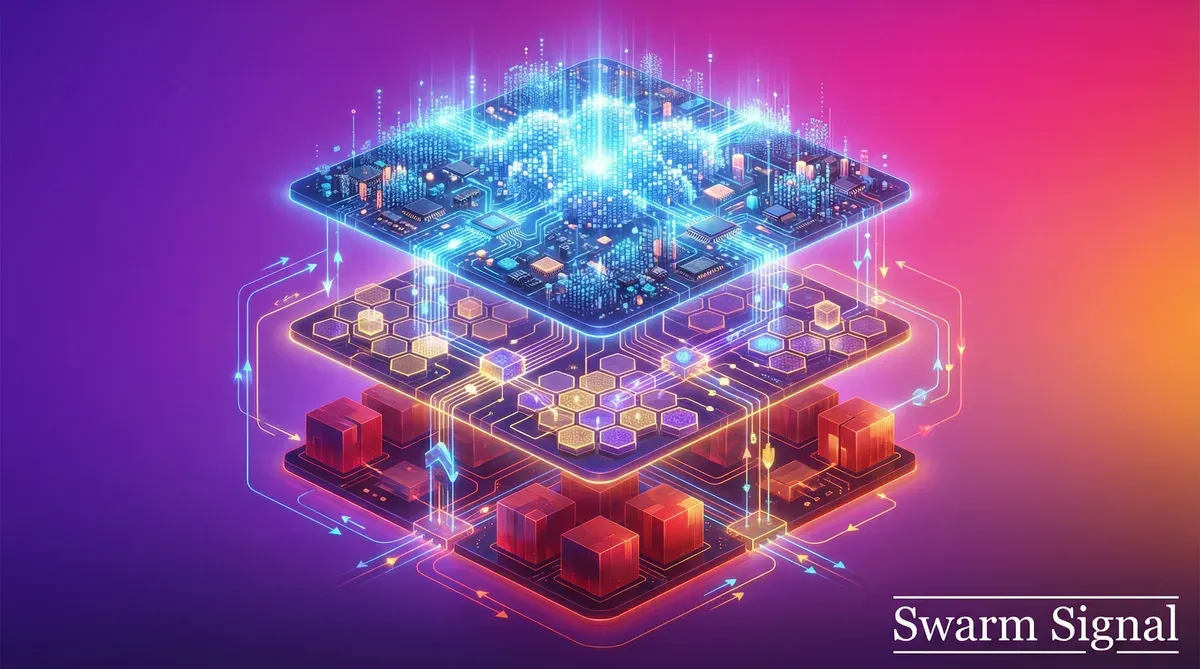
Most teams treat vector databases as fancy search indexes. The teams building agents that actually remember treat them as memory systems: with tiered architecture, decay policies, and retrieval strategies that mirror how memory actually works.
The naive RAG pipeline fails silently on every query that requires reasoning. From iterative retrieval to agentic loops, here are the architecture patterns that separate demos from production systems.
Prompt engineering hit its ceiling. The teams pulling ahead now are engineering context: retrieval, memory, tool access, not tweaking instructions. Context is the new prompt.
Every major cloud vendor and analyst firm agrees: 2026 is the year AI agents go from pilot to production. The data backs them up, but it also reveals the gap between adoption and outcomes is wider than anyone's admitting.
The models have never been better. The deployment rate has never been worse. What's actually breaking between 'it works in a notebook' and 'it runs in production.'
RAG is the industry's default answer to hallucination. The research says it's not enough.
The AI industry's defining bottleneck has shifted from architecture and compute to something far less glamorous: the data itself.
As agents gain autonomy over communication, inspection, and resource negotiation, three converging patterns are redefining multi-agent infrastructure: dynamic topology, embedded auditing, and adversarial trade.
The next generation of agents will not be defined by peak capability but by their ability to match effort to difficulty. Across every subsystem, the field is converging on the same fix: budget-aware routing.
Lab benchmarks show multi-agent systems coordinating well. Deploy them in messy reality and three kinds of friction emerge that no architecture diagram accounted for.
Automated adversarial tools are emerging where small, cheap models systematically find vulnerabilities in frontier models. The safety landscape is shifting from pre-deployment testing to continuous monitoring.
New research shows AI agents don't just learn human capabilities; they systematically inherit human cognitive biases. The implications for deploying agents as objective decision-makers are uncomfortable.
Three independent papers demonstrate agents rewriting their own training code, generating their own knowledge structures, and refining their reasoning at test time. Self-improvement has moved from theory to working engineering.
AI benchmarks measure performance in sanitized environments that bear little resemblance to conditions where these systems will actually operate.
Models you can download but can't verify, use but can't fully trust, deploy but can't completely understand. The paradox of 'open' AI.
The first generation of agents treated tools as static functions. The emerging generation reasons about tools, remembers usage patterns, and adapts to heterogeneous interfaces.
On frontier models, sophisticated prompting underperforms zero-shot queries. The techniques that made mid-tier models usable are now making frontier models worse.
Multimodal agents are navigating websites, controlling robots, and generating 3D scenes. But perception is the bottleneck, and bridging it requires rethinking how models attend to the world.
A robot arm completing 84.9% of manipulation tasks without a single demonstration. Not through months of reinforcement learning: through pure language model reasoning. The line between software agents and physical robots is blurring.
Mechanistic interpretability has moved from describing what models do to engineering how they work. If you can identify the neurons responsible for a specific behavior, you don't need to control the entire system.

OpenAI's o1 jumped from the 11th to the 83rd percentile on competitive programming. The difference wasn't better data or more parameters; it was reasoning tokens, invisible chains of thought that let models think before they answer.
Stanford deployed 25 agents that planned a party autonomously. But most production agents today can't remember what you told them ten minutes ago. The memory problem isn't a model limitation; it's an architectural one, and new solutions are emerging.
Agents have moved from academic benchmarks to production systems processing millions of conversations. The gap between hype and reality comes down to architecture. This guide walks through model selection, tool design, and instruction engineering with production examples.
Queue is empty. Click "+ Queue" on any article to add it.