

🎧 LISTEN TO THIS ARTICLE
Your RAG pipeline retrieves the right documents. The LLM ignores half of them. This isn't a hypothetical failure mode. It's the default behavior of every production retrieval system, and most teams never notice because their evaluation frameworks don't measure it.
The Retrieval-Utilization Gap
The assumption behind RAG is straightforward: give the model relevant context, get a grounded answer. But a growing body of research shows that retrieval and utilization are separate problems, and solving the first doesn't guarantee the second.
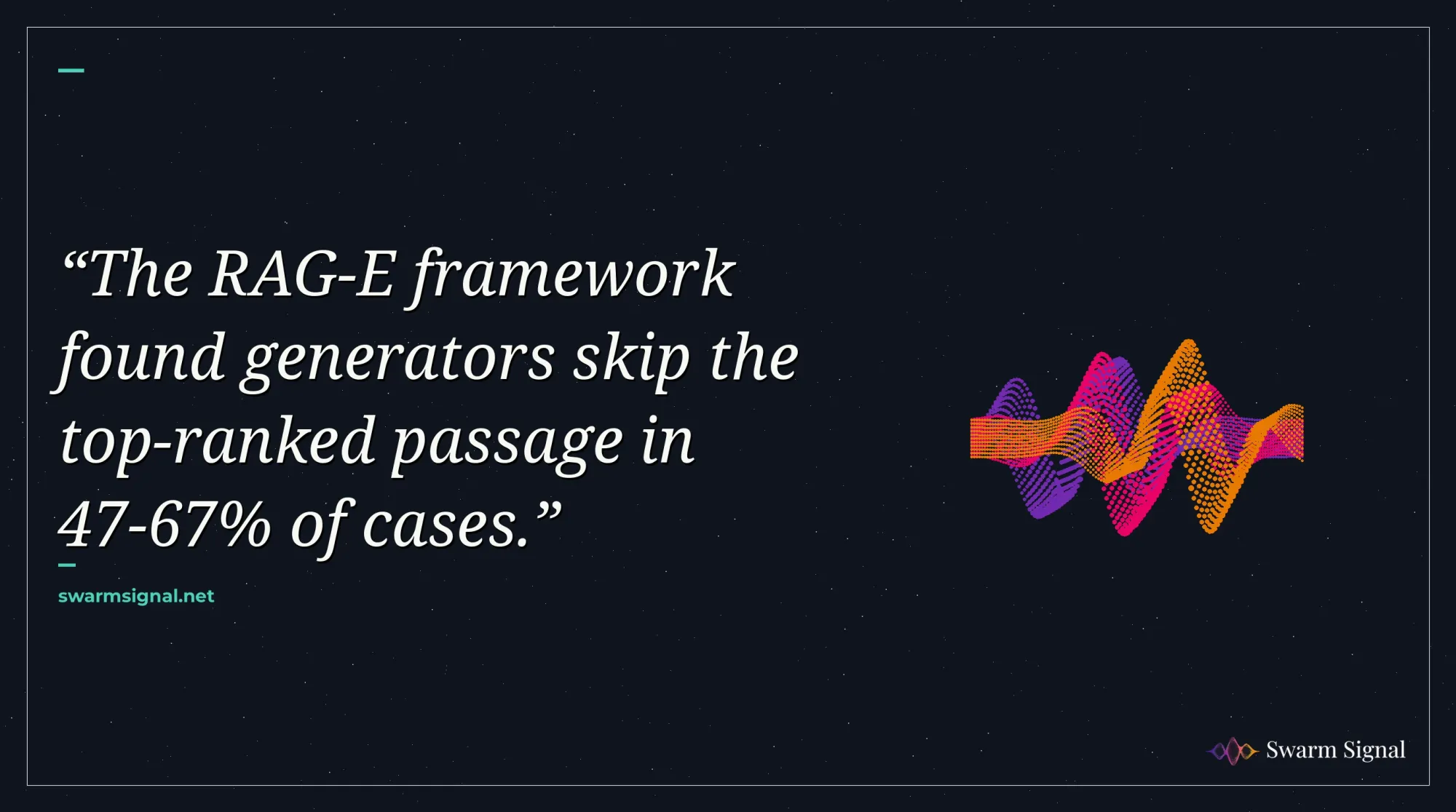
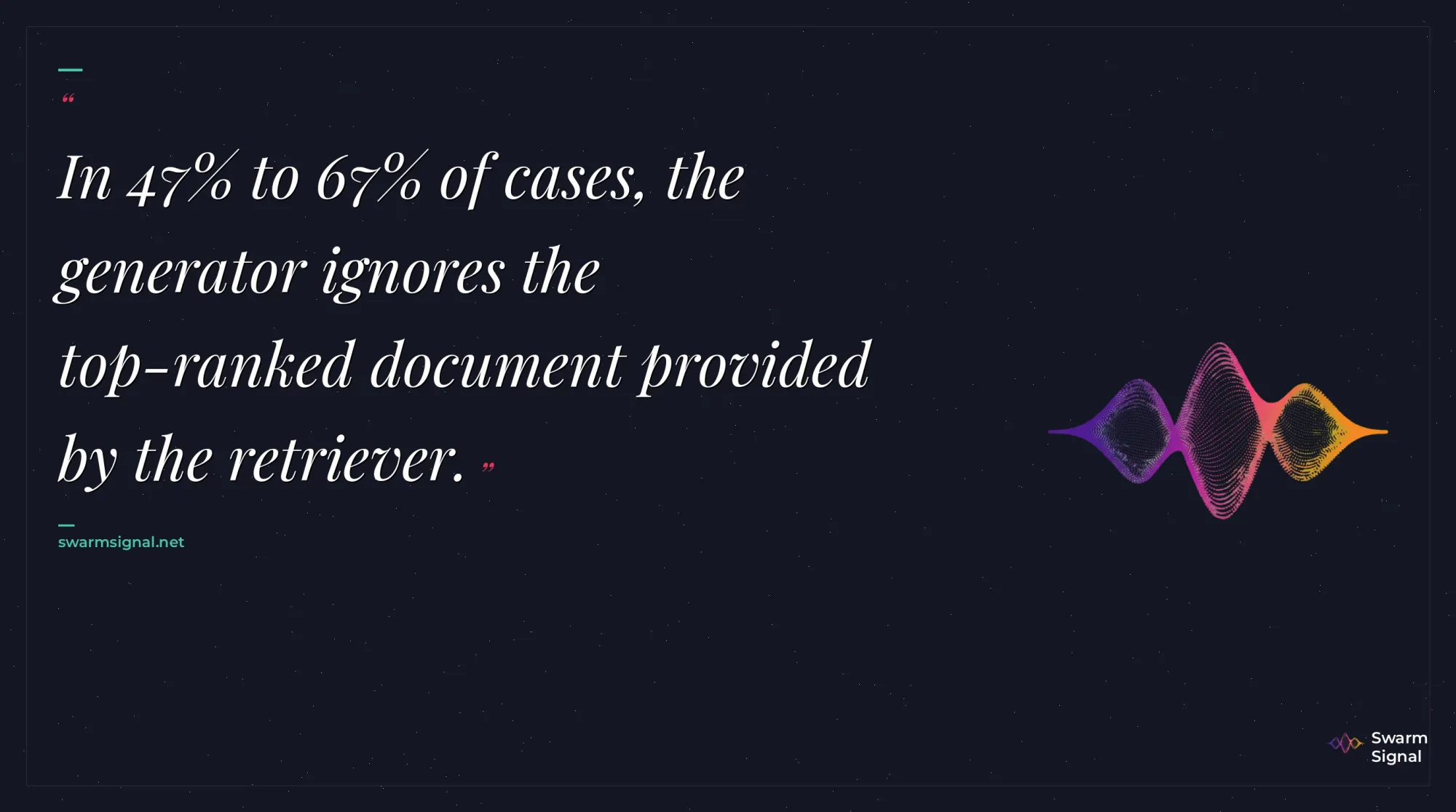
The RAG-E framework, published in early 2026, quantified this directly. In 47% to 67% of cases, the generator ignores the top-ranked document provided by the retriever. Models frequently rely on lower-ranked, less relevant passages to formulate answers, or fall back on parametric memory entirely. The retriever optimizes for similarity. The generator optimizes for coherence. When those objectives conflict, context gets dropped.
This gap compounds with scale. The more documents you stuff into the prompt, the worse the problem gets. Chroma Research tested 18 frontier models including GPT-4.1, Claude Opus 4, and Gemini 2.5 on context utilization tasks. Every model showed degradation as input length increased. Claude models decayed the slowest, but none were immune. Researcher Kelly Hong described the pattern as "context rot": as you add more information to a prompt, models don't just slow down. They start forgetting, hallucinating, and failing at tasks they would have handled at smaller input sizes.
Lost in the Middle
The decay isn't uniform. Models attend more strongly to the beginning and end of the context window, while information placed in the middle receives weaker attention. This is the "lost in the middle" effect, first identified in 2023 and confirmed repeatedly since. Long-context LLMs often miss information placed mid-sequence, driven by positional biases like RoPE decay.
For RAG pipelines, this means chunk ordering directly affects answer quality. If your most relevant passage lands in position 4 of 10 retrieved documents, it sits in the attention dead zone. The model is more likely to use passage 1 or passage 10, regardless of their actual relevance. Teams that retrieve 20 chunks and pass them all to the model aren't being thorough. They're actively degrading their system's performance.
Insufficient Context Looks Like Hallucination
Google Research presented a study at ICLR 2025 that reframes the problem further. Their "Sufficient Context" analysis showed that context relevance is the wrong metric. What matters is whether the retrieved passages contain enough information for the model to answer the question.
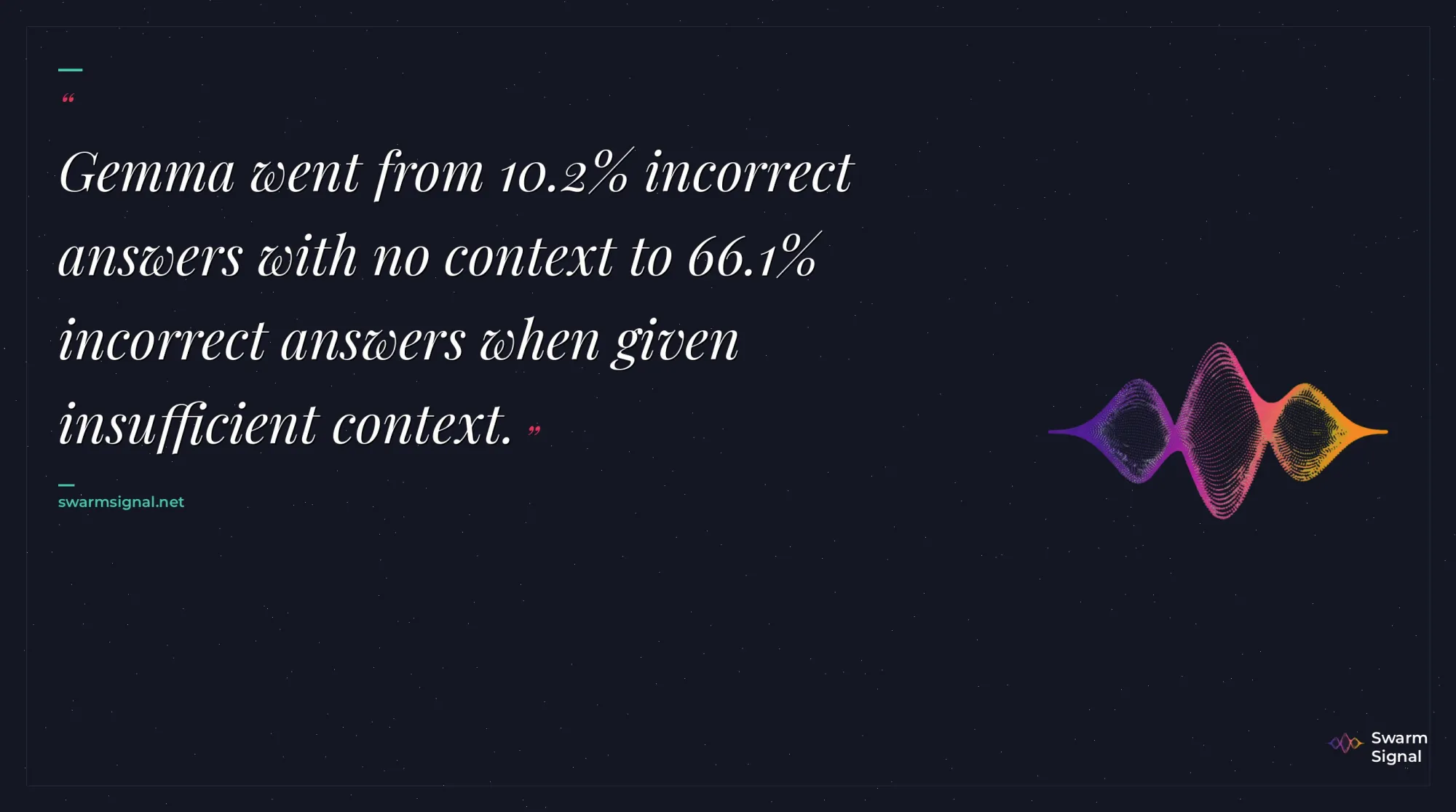
The findings were counterintuitive. RAG generally improves overall performance, but it reduces the model's ability to abstain when it should. Additional context increases confidence even when the context is insufficient, leading to hallucination rather than honest uncertainty. In one case, Gemma went from 10.2% incorrect answers with no context to 66.1% incorrect answers when given insufficient context. The retrieval system made the model worse by giving it just enough information to be confidently wrong.
What Actually Helps
The research points toward three practical fixes that address context dropping at different stages.
Retrieve less, rank more. Two-stage retrieval with cross-encoder reranking consistently outperforms single-pass vector search. Keep only the 3 to 5 most relevant passages rather than flooding the context window. Microsoft's production benchmarks show hybrid retrieval with semantic ranking outperforming pure vector search.
Order strategically. Place the highest-confidence documents at the beginning and end of the prompt. Push lower-ranked passages to the middle where they'll do the least damage if ignored.
Filter before generation. Context filtering approaches like FILCO strip irrelevant spans from retrieved passages before they reach the generator, reducing prompt length by up to 64% while improving answer quality across extractive QA, fact verification, and multi-hop reasoning tasks.
These aren't exotic techniques. They're basic pipeline hygiene that most production systems skip because the failure mode is invisible. Your RAG system returns an answer. It looks plausible. The evaluation suite gives it a passing score. But three of the five retrieved documents were never used, and the answer is built on parametric memory plus a single cherry-picked passage.
The RAG reliability gap isn't closing on its own. For teams building retrieval systems that need to actually ground their outputs, the path forward starts with measuring what the model does with retrieved context, not just whether the retriever found it. Until you instrument that gap, you're flying blind. And as anyone who has worked through agent memory architecture already knows, the memories are usually there. The model just can't find them, or won't use them.
Sources
Research Papers:
- RAG-E: Retriever-Generator Alignment — arxiv (2026)
- Sufficient Context: A New Lens on RAG Systems — Google Research, ICLR 2025
- FILCO: Learning to Filter Context for RAG — arxiv (2023)
Industry Research:
- Chroma Research: Context Rot in LLMs — Cobus Greyling (2025)
- Azure AI Search: Hybrid Retrieval and Reranking — Microsoft Tech Community
Related Swarm Signal Coverage: